






Seeing the Detail, Following the Motion: What Radar Imaging and Tracking Really Deliver
From centimeter-grade images to moving-target separation and live tracks — five capabilities that turn raw echoes into decisions.
Radar Imaging & Tracking Team · ~8 min read · Product & Solution Brief
A radar that only tells you "something is out there" is not enough. The work that matters starts after detection: resolving what the object is, telling what is moving from what is not, measuring how fast it goes, and keeping a live track on it. Those five terms — high-resolution imaging, moving-target discrimination, velocity estimation, stationary-versus-dynamic separation, and real-time tracking — are not separate features. They are one pipeline, and each step makes the next one possible.
1 High-Resolution Imaging: First You Have to See the Shape
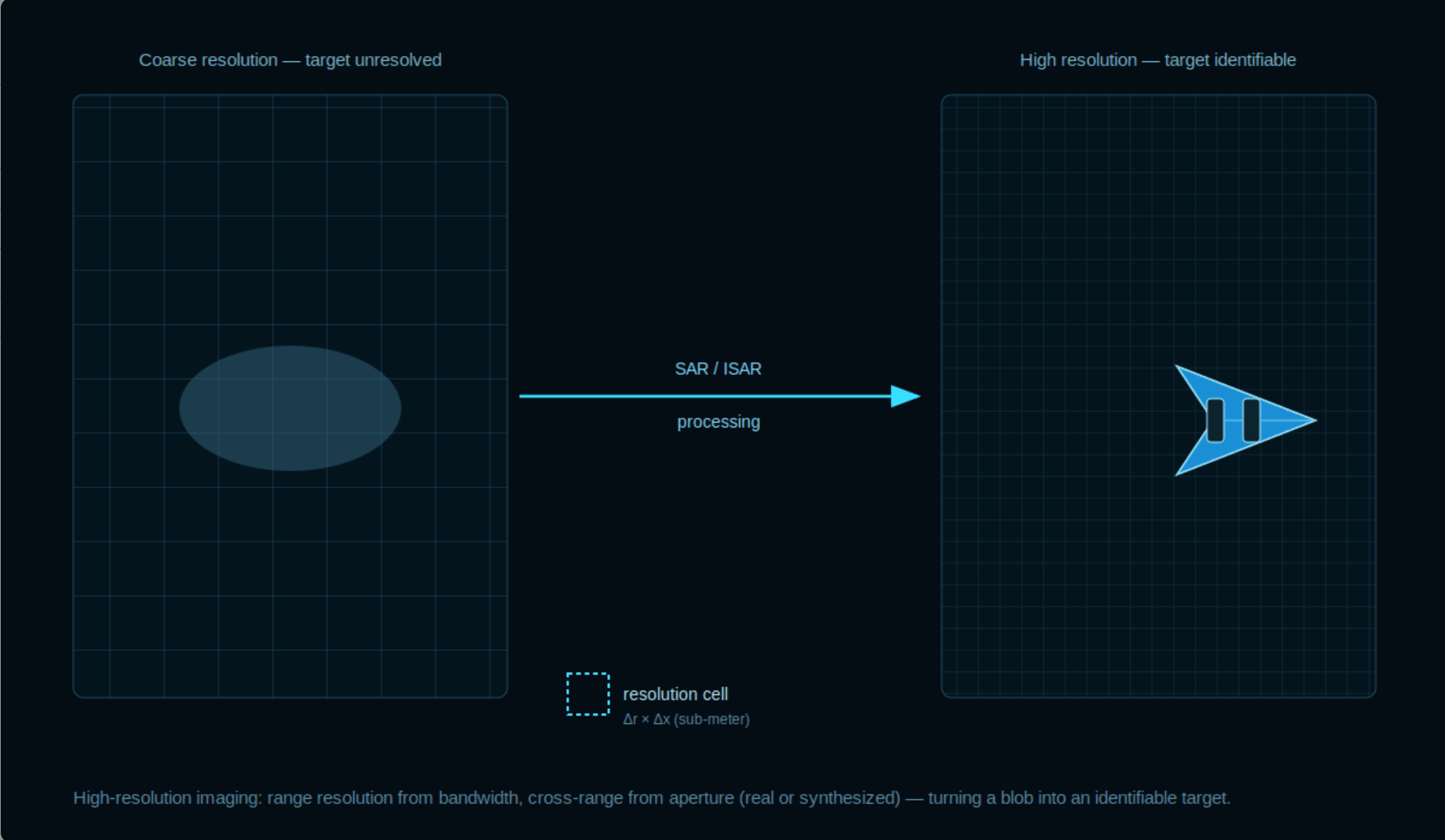
Resolution is what separates "a blob" from "a target you can name." Synthetic aperture radar (SAR) on a moving platform, or inverse SAR (ISAR) on the target itself, trades observation time and coherent processing for fine cells — from meters down to sub-meter, sometimes tens of centimeters. Range resolution comes from signal bandwidth; cross-range comes from the aperture, real or synthesized. The point is not the number on a slide; it is what you can do with it: count the vehicles, read the silhouette, spot the structure that changed since last week.
But resolution has a catch, and it only helps once the image is focused. Motion during the coherent interval smears everything — which is exactly why the next steps exist. A sharp image is the floor the rest of the chain stands on.
Figure 1. SAR / ISAR processing resolves targets to sub-meter class in both range and cross-range.
|
Resolution is two numbers, not one — range (along the pulse) and cross-range (across it). Miss either and you misjudge what you are looking at. |
2 Moving-Target Discrimination: Not Every Blip Deserves a Second Look
Once you can image, the next question is which returns actually matter. Most things in a scene sit still; a few move. Moving-target discrimination is the filter that flags the movers — a parked truck is background, a truck pulling away is a report. It keys off the one thing stationary clutter cannot fake: relative motion.
In practice this rides on the Doppler shift and on how a target's return behaves across coherent pulses. A good discriminator keeps false alarms down when the scene is busy and the weather is bad, because that is exactly when operators stop trusting the screen. It is the difference between a sensor that buries you in contacts and one that points at the few that matter.
Figure 2. Relative motion — not amplitude — separates movers (bright, with velocity vectors) from static clutter (dim).
3 Velocity Estimation: Motion Is a Number, Not a Vibe
Flagging a mover is one thing; saying how fast is another. Velocity estimation reads the Doppler frequency and turns it into radial speed — for a monostatic radar, v = λ·f_D / 2. Closing or opening range rate becomes a measured quantity you can plan around, not a guess.
Real scenes stay messy: a target rarely heads straight at the radar, so you get radial velocity, not true ground speed, and a turn flips the sign. Good estimation reports its own uncertainty too, not just a point value, because a track that knows its error is a track you can hand to a decision. The speed also feeds the classifier — a slow crawl and a fast dash are different problems.
Figure 3. A moving contact sits off the zero-Doppler line; the offset is a measured radial speed, with its own uncertainty.
4 Stationary-vs-Dynamic Separation: Pull the Movers Out of the Clutter
This is where discrimination meets signal processing. Stationary objects and the ground share roughly the same Doppler (near zero); moving objects do not. Clutter suppression — STAP, displaced-phase-center tricks, or simple Doppler notching — cancels the static return and leaves the dynamic one standing. That is how a slow vehicle hides in plain sight on a SAR image yet lights up on a GMTI pass.
The hard part is never the math; it is the edge cases. A target moving at the same speed as the surrounding clutter. A tree line swaying in wind. A road full of traffic where you only want the outlier. Separation that holds up there is what makes the whole system usable, not just demonstrable on a clean slide.
Figure 4. Cancel the zero-Doppler return and the movers stay; the same scene, clutter removed.
5 Real-Time Tracking: Keep a Live Story, Not a Snapshot
A single detection is a moment; a track is a story. Real-time tracking takes the separated, velocity-tagged movers and maintains them across updates — starting tracks, associating new plots to old ones, coasting through brief dropouts, and dropping tracks that fade. Multiple targets, crossing paths, and intermittent returns all have to be handled without the display turning into spaghetti.
"Real-time" is the load-bearing word. It means the whole pipeline — image, discriminate, estimate, separate, track — closes inside the update interval, so the operator sees now, not five seconds ago. That is what lets one system watch a wide area and still hand off clean tracks to whatever acts on them.
Figure 5. Multi-target tracks with history, association, and predicted positions, maintained inside the update interval.
We Build These Five Steps as One Pipeline
Separate, they are algorithms. Together, they are a working sense of the battlespace. Our TrackSense Radar Imaging and Tracking Platform runs the full chain — high-resolution imaging through live multi-target tracking — as one coherent workflow:
|
Image sharply |
SAR / ISAR processing to sub-meter-class resolution in range and cross-range, with autofocus for moving scenes. |
|
Flag the movers |
Moving-target discrimination that holds false-alarm rates down in cluttered, adverse conditions. |
|
Measure the speed |
Doppler-based velocity estimation reported with uncertainty, not just a point read. |
|
Split static from dynamic |
Clutter suppression (STAP / DPCA / notching) that isolates movers from the stationary return. |
|
Track in real time |
Multi-target tracking with association, coasting, and handoff, all inside the update interval. |
|
Close the loop |
Imaging, discrimination, velocity, and tracks on one timeline, ready for the downstream decision. |
Book a live demo · Download the TrackSense technical brief
The value of radar imaging and tracking is not a prettier picture; it is a shorter path from echo to decision. Image it, separate the movers, estimate their speed, and keep them tracked — do that in real time and the picture stops being something you interpret and starts being something you act on.