






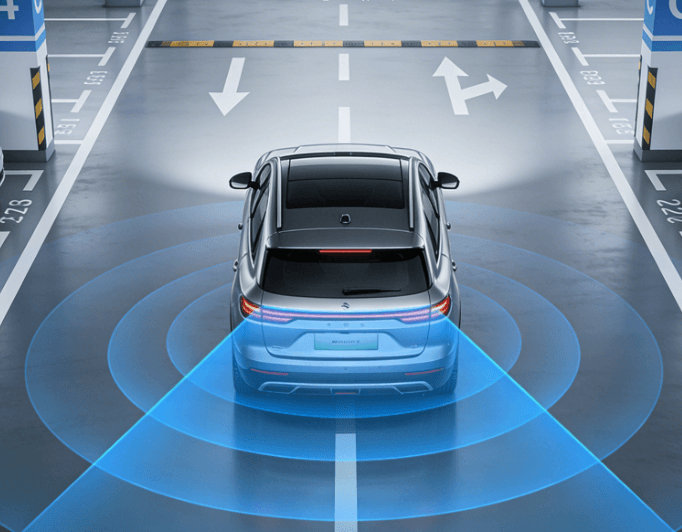
Industry Background: Parking Is Not a Low-Complexity Scenario
In the development of autonomous driving technology, parking has often been perceived as a “low-speed, low-risk” scenario. Due to its relatively controlled environment, automated parking has long been regarded as an entry point for autonomous driving, often misunderstood as technically simple. However, as automation progresses from Automated Parking System (APS) to Home Zone Parking Pilot (HPP) and eventually to Automated Valet Parking (AVP), this perception is increasingly challenged.
Engineering experience shows that parking environments demand high levels of stability, continuity, and reliability from perception systems. In fully unattended parking scenarios, even brief perception failures can directly affect vehicle safety and system availability. Therefore, perception redundancy has shifted from an optional feature to a core system design principle.
The Engineering Reality of Parking Environments
Parking lots are highly unstructured and complex environments. Underground areas often have inconsistent lighting conditions, with low light, backlight, and artificial illumination coexisting. Entrance and exit zones can experience extreme brightness changes. In addition, parking lots contain various obstacles, such as ground locks, columns, cones, suspended pipes, pedestrians, and delivery vehicles. These objects vary in shape and size and lack standardized features. Frequent occlusions caused by adjacent vehicles, walls, and pillars further challenge the perception system, which must detect, classify, and plan paths within very short timeframes.
In such conditions, limitations of single-modality perception are magnified. Camera-based vision excels at semantic understanding but is sensitive to lighting, lens contamination, and low-texture surfaces, which may reduce depth accuracy and object detection reliability. Ultrasonic sensors perform well for short-range collision avoidance but lack spatial imaging capabilities and cannot provide holistic environmental awareness. In unattended parking scenarios, these limitations can directly impact system availability.
Evolution of Automated Parking Levels and Perception Requirements
As automated parking evolves from APS to HPP and finally to AVP, the responsibility and requirements of perception systems increase substantially.
APS (Automated Parking System)
APS relies primarily on ultrasonic sensors for near-range obstacle detection, with cameras assisting in identifying parking lines. Drivers remain in the vehicle and can intervene if needed, so tolerance for failure is relatively high.
HPP (Home Zone Parking Pilot)
HPP enables vehicles to autonomously navigate and memorize fixed paths within a designated area. The perception system must continuously track targets and maintain reliable positioning in dynamic environments.
AVP (Automated Valet Parking)
AVP represents a Level 4 autonomous scenario where drivers are not present. The system must operate reliably under various environmental conditions. This requires perception systems to provide redundancy across different sensing modalities, ensuring safe operation even if one sensor fails.
Limitations of Vision-Only Parking Solutions
Although visual algorithms have made significant progress, vision-only approaches have inherent limitations in parking scenarios. Low-texture surfaces such as white walls or polished floors can reduce depth estimation accuracy. Rain, dust, and lens contamination affect camera imaging. Processing multiple high-resolution camera streams in low-speed environments also imposes significant computational load and latency challenges. These factors indicate that vision-only solutions cannot guarantee continuous availability in AVP scenarios without complementary sensors.
System-Level Value of 4D mmWave Radar
4D mmWave radar introduces an elevation dimension, enabling the sensor to output more complete spatial information. Its value in parking scenarios includes:
-
Spatial Obstacle Recognition: Differentiates between traversable objects and true obstacles such as ground locks, curbs, and hanging objects, reducing unnecessary braking.
-
Target Separation in Dense Environments: High angular resolution enables distinction between closely spaced pedestrians, vehicles, and columns, providing reliable input for path planning.
-
All-Weather Physical Redundancy: Millimeter-wave radar operates independently of light and is less affected by rain, dust, or smoke, maintaining distance and velocity measurements when cameras are impaired.
These features make 4D radar a critical redundancy sensor, extending the operational envelope of unattended parking systems without relying on a single sensor for absolute reliability.
Multi-Modal Fusion and System Reliability
Modern AVP architectures employ multi-modal fusion. Vision handles semantic understanding, ultrasonic sensors manage near-range collision avoidance, and 4D mmWave radar covers long-range dynamic and static obstacles while providing redundancy when vision is impaired. This heterogeneous redundancy reduces overall failure probability and increases system availability in real-world parking environments.
Future Trends and Core System Capability
As 4D mmWave radar technology matures and costs decline, its role is evolving from supplemental perception to a foundational system capability. In underground or GPS-denied environments, radar point clouds assist in positioning and environmental mapping, providing high-precision perception support for autonomous parking. This trend demonstrates that radar's value extends beyond obstacle avoidance, forming an essential part of reliable unattended parking systems.
Conclusion
From APS to AVP, the evolution of automated parking technology has shifted focus from “whether automatic parking is possible” to “how reliably it can operate in complex environments.” 4D mmWave radar provides three-dimensional spatial awareness, all-weather reliability, and physical redundancy, supporting unattended parking systems at the engineering level. Its value lies in system-level reliability and multi-modal coordination, enabling automated parking technology to operate safely and continuously in real-world conditions.