







The Blind Spot in Radar Reliability: When Signals Lie
Automotive perception stacks and industrial autonomous guided vehicles have leaned heavily on millimeter-wave (mmWave) radar to handle conditions where vision systems fall apart—dense fog, torrential rain, and low-contrast factory floors. Yet, for years, system architects treated radar point clouds as inherently trustworthy physical facts. That assumption is unraveling. As low-cost software-defined radios (SDRs) and commercial RF generators have matured, active RF injection and phantom target generation have moved from academic security conferences directly into field-level safety risks. Implementing robust anti-spoofing radar signal validation is no longer an exotic defense requirement; it has become an essential baseline for any system relying on radar for safety-critical path planning and emergency braking.
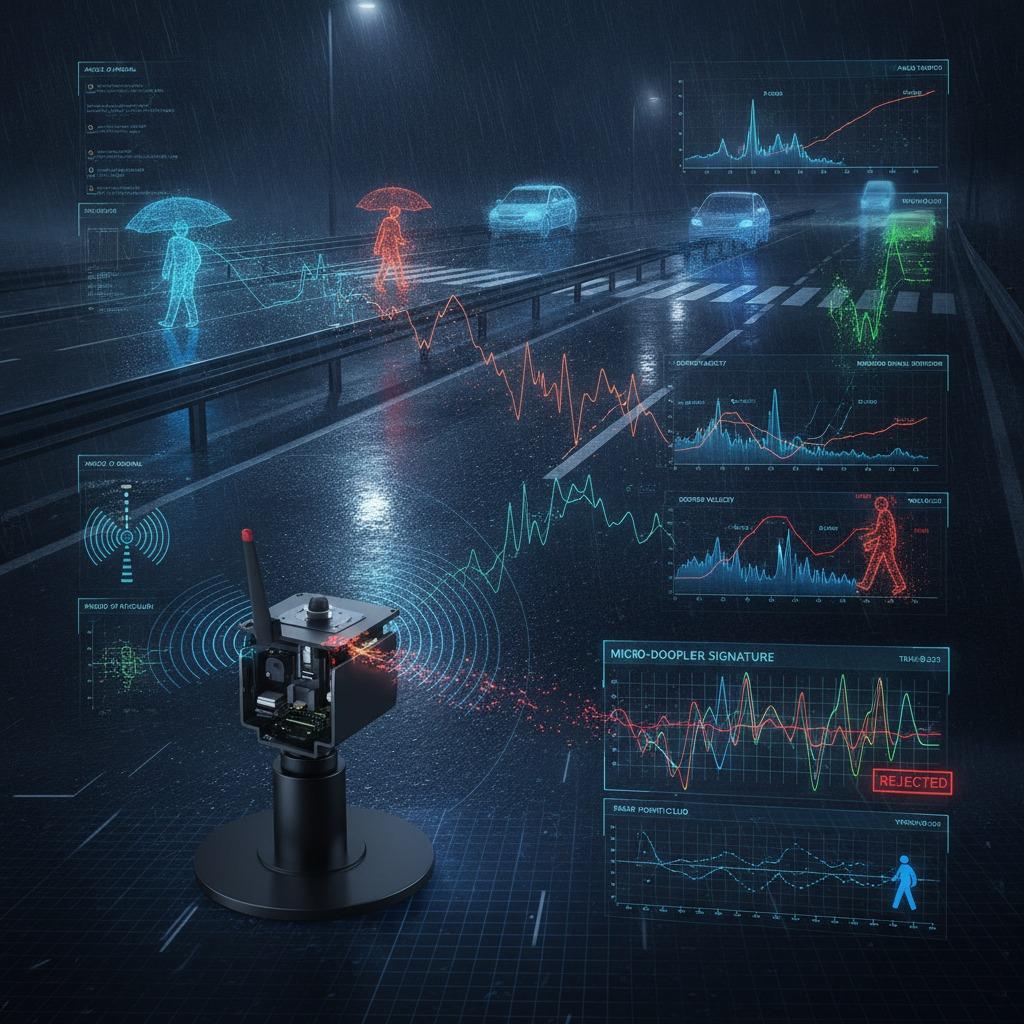
The core vulnerability stems from predictability. Most commercial frequency-modulated continuous-wave (FMCW) radars emit uniform chirps with predictable ramp slopes, intervals, and bandwidths. An adversary or an unsynchronized secondary emitter does not need to crack an encryption key to disrupt these systems; they merely need to capture a chirp sequence, apply a slight delay or Doppler frequency offset, and retransmit it. The radar's processing engine ingests the reflected signal, calculates range and velocity using standard fast Fourier transforms (FFTs), and generates ghost obstacles—or worse, masks real obstacles. Resolving this requires defense-in-depth spanning waveform physics, DSP heuristics, and bus-level data integrity.
Layer 1: Waveform Agility and Physical-Layer Verification
The first line of defense must happen at the radio frequency front-end before raw intermediate frequency (IF) signals are down-converted and processed into targets. Fixed chirp timing makes a sensor an open target. Transitioning to randomized pulse repetition intervals (PRI) and dynamic chirp modulation breaks the predictable timing window that spoofers rely on to inject coherent signals.
When the radar transceiver constantly varies chirp slope, start frequency, or inter-chirp idle time based on a pseudorandom sequence known only to the local radar controller, retransmitted spoofed signals arrive out of sync. To the radar processor, an unsynchronized retransmission manifests as uncorrelated background noise rather than a focused energy peak in the range-Doppler map. Furthermore, dual-polarization antennas can cross-check returning polarization signatures. Man-made spoofing signals rarely replicate the exact depolarization behavior of real-world obstacles like stamped sheet metal or wet asphalt.
Layer 2: Algorithmic Sanity and Radar Data Authentication
Waveform unpredictability helps, but it does not completely eliminate sophisticated electronic attacks, such as synchronized digital RF memory (DRFM) systems. Therefore, baseband firmware must incorporate real-time heuristic checks before packaging point clouds for transmission across the vehicle or machine network. This is where radar data authentication connects physical dynamics with signal characteristics.
A physically valid target exhibits consistency across multiple physical domains:
- Angle-of-Arrival (AoA) vs. Doppler Alignment: A ghost target injected via a single stationary emitter cannot convincingly simulate distinct spatial directions for multiple targets while simultaneously shifting their Doppler velocities. Heuristic filters should flag detections where AoA phase differences do not match expected trajectory physics.
- Received Signal Strength (RSS) Profiles: Spoofed chirps often exhibit flat, unnaturally high amplitude profiles across broad angles. Legitimate targets follow the radar range equation, where returned power drops predictably with distance. Anomalous spikes in amplitude that bypass free-space path loss curves should immediately trigger tamper detection for sensing data.
- Micro-Doppler Signatures: Complex targets like walking pedestrians or rotating machinery produce unique micro-Doppler sidebands. While costly in processing overhead, running targeted micro-Doppler classification on unexpected static or high-speed detections acts as an effective secondary validation gate.
Layer 3: Securing the Data Bus and Backend Integrity
Validating the RF front-end is half the battle; the resulting telemetry must still survive the trip to the central domain controller. In older vehicle designs, raw radar outputs or object lists were broadcast over unprotected CAN or low-speed Ethernet buses. Once an attacker breaches a peripheral ECU, injecting fabricated radar frames onto the bus completely bypasses front-end defenses.
Modern system architectures require secure sensor data transmission using authenticated protocols such as CAN-FD with Secure Onboard Communication (SecOC) or Ethernet backbones hardened with MACsec. By binding each radar frame with a cryptographic message authentication code (MAC) generated by an onboard hardware security module (HSM), the central processor verifies that the object list genuinely originated from the radar unit and was not intercepted or modified in flight.
Alongside bus security, continuous integrity monitoring of radar output should operate at the fusion layer. If a high-confidence radar target appears inside a clear travel lane but forward cameras and ultrasonic sensors register open ground, the perception engine should not simply average the inputs. Instead, the system must cross-evaluate the sensor confidence scores, verify whether the radar unit has flagged any RF interference flags, and degrade operational speed safely rather than executing an abrupt, dangerous phantom brake.
Practical Engineering Trade-offs: Latency vs. Protection
Integrating anti-spoofing mechanisms is never cost-free, and systems engineers must balance defense against real-world performance budgets. Introducing heavy cryptographic handshakes across every chirp is technically impractical due to microsecond timing limits. Similarly, deep micro-Doppler evaluation on hundreds of point clusters can overwhelm embedded DSP cores and blow past typical 50 ms cycle times.
A practical compromise used in current industrial deployments is tiered validation: apply lightweight physical-layer chirp randomization continuously across all scans, run statistical anomaly checks on the top 10% highest-risk targets (those directly in the vehicle path), and append hardware-accelerated cryptographic tags only to packaged object summaries rather than raw baseband streams. This keeps baseband latency predictable while still shutting down bulk RF injection attempts.
Frequently Asked Questions
What is the difference between radar jamming and radar spoofing?
Jamming floods the radar receiver with high-power RF noise, blinding the sensor and raising the noise floor so that real targets cannot be resolved. The radar knows it is jammed because the receiver saturates. Spoofing is far more dangerous: it injects structured, deceptive signals designed to make the radar believe a non-existent target is present (or that a real target is elsewhere) without necessarily triggering a high-noise fault.
Can multi-sensor fusion replace anti-spoofing checks at the radar level?
Sensor fusion helps catch discrepancies, but relying solely on downstream fusion is dangerous. If a spoofed radar target forces a critical safety response (like an autonomous emergency brake) before the fusion pipeline can resolve conflicts with optical cameras—especially in bad weather where cameras are degraded—the spoofing attack succeeds. Validation must occur as close to the physical antenna array as possible.
Does FMCW chirp randomization degrade radar measurement resolution?
It can introduce slight phase noise or increase sidelobe levels in the range-Doppler map if not carefully managed. However, modern radar front-ends utilize digital phase-locked loops (PLLs) capable of switching ramp parameters with nanosecond precision, minimizing trade-offs in velocity or range resolution when matched filtering algorithms are adjusted accordingly.
Next Steps for System Architects
Evaluating existing radar deployments starts with an RF penetration and vulnerability audit. Engineering teams should review their current radar silicon roadmaps to verify whether upcoming transceivers support pseudorandom chirp sequencing, on-die HSM acceleration, and hardware-level signal quality diagnostics. Designing safety-critical automation requires treating RF signals not as guaranteed physical truth, but as unverified network inputs that require continuous validation from antenna to actuator.