






Why EMI shielding has become a design issue, not a finishing touch
Electromagnetic interference (EMI) shielding is no longer something engineers can leave to the last layout review. As devices get smaller, radios multiply, and product cycles tighten, unwanted noise moves from a nuisance to a direct risk to performance, compliance, and field reliability. A board that works on the bench can behave very differently once it sits inside a plastic housing, next to a motor drive, a switching supply, or another wireless subsystem that was never meant to share the same space.
That is why EMI shielding matters to sourcing teams and product engineers alike. The real decision is not simply whether to add shielding, but what kind of shielding is needed, where it belongs, and how much performance margin the design can afford to lose if the wrong choice is made.

What EMI shielding is really trying to solve
At a practical level, EMI shielding aims to control two problems: emissions leaving a device and outside noise entering it. Both can disrupt radios, sensors, control electronics, and power systems. In wireless products, the stakes rise further when designs depend on frequency agility, co-channel interference cancellation, spectrum coexistence, or jamming resilience. Those capabilities help a system adapt in a crowded environment, but they do not replace physical shielding. A radio can only do so much if the enclosure, cable routing, or connector stack-up is radiating noise into the front end.
Buyers often assume shielding is only about compliance testing. That is too narrow. It also affects signal quality, thermal behavior, serviceability, and cost. A shielding choice that solves one issue can create another if it blocks airflow, complicates assembly, or adds secondary operations on the line.
Common shielding approaches and where they fit
There is no single best method. The right solution depends on the source of the interference, the frequency range, the enclosure material, and whether the problem is local to one component or system-wide.
Conductive enclosures and covers
Metal housings, shields, cans, and lids are the most straightforward answer when a noisy component needs a physical barrier. They are often effective for localized hotspots around RF sections, clocks, processors, and power stages. The trade-off is obvious: metal adds part count, can raise cost, and may complicate mechanical design if grounding points are not handled carefully.
Conductive gaskets and interface materials
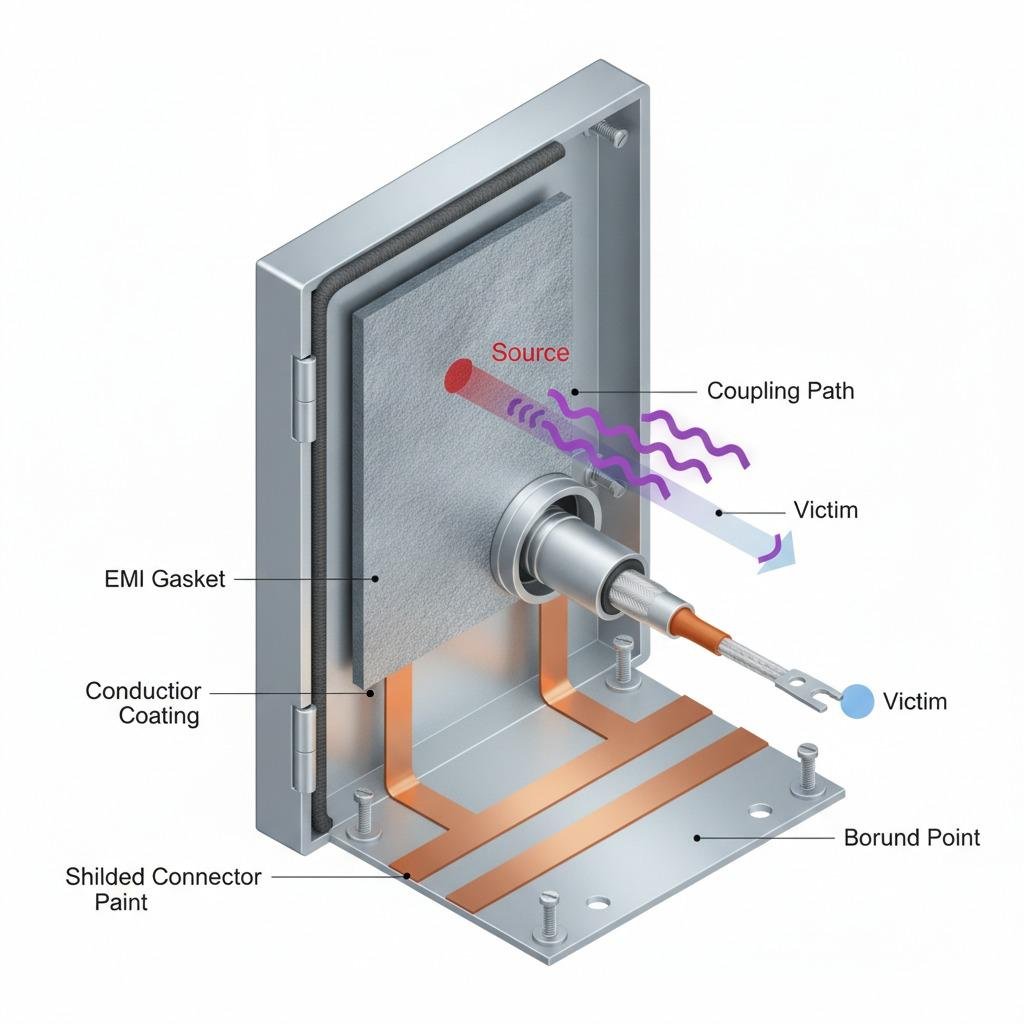
Where enclosures meet, seams are often the weak point. Conductive gaskets, finger stock, and similar interface materials help maintain continuity across joints, doors, and removable covers. They matter more than many teams expect. A strong shield with a poor seam can still leak badly, especially at higher frequencies.
Coatings, films, and plated surfaces
For plastic housings or lightweight assemblies, conductive coatings and metallized films can provide shielding without switching the entire product to metal. These options can be attractive when weight or aesthetics matter. Still, buyers should be cautious about process control, adhesion, and consistency across production lots. A coating that looks fine on first article samples may be less forgiving in volume builds.
How to choose the right shielding strategy
Good selection starts with failure analysis, not with material preference. Ask where the interference comes from, how it couples into the sensitive circuit, and whether the issue is radiated, conducted, or both. Then map the frequency range involved. Lower-frequency problems may call for different approaches than high-frequency leakage around fast digital edges or RF modules.
From there, the selection usually comes down to a few practical questions. Does the product need maximum enclosure continuity, or only local protection around one subsystem? Can the assembly tolerate added thickness, weight, or heat retention? Will the supplier be able to hold process consistency across the full production run? These are the questions that determine whether a shielding solution stays effective after launch, not just in the lab.
Common mistakes that create avoidable rework
One frequent mistake is treating shielding as a cure for poor layout. If a board has bad return paths, noisy cable exits, or careless partitioning, shielding may only hide the symptom. Another is ignoring the mechanical interface. Small gaps, paint at a ground contact, or poorly controlled fastener torque can turn a decent concept into an intermittent problem.
Teams also underestimate integration time. Shielding often affects assembly sequence, test access, rework, and even documentation. A sourcing decision that looks clean on paper can create production headaches if the supplier cannot support repeatable fit-up or if the design needs late changes.
What product teams should ask before buying
For engineers and sourcing managers, the best questions are practical ones: Where is the dominant interference path? What is the smallest effective shielding area? Which surfaces must remain conductive after assembly and over life? Will the chosen method still work after thermal cycling, vibration, or repeated service access? If a vendor cannot answer those questions clearly, that is usually a warning sign.
It also helps to request application-specific guidance instead of generic material claims. EMI shielding is rarely a catalog purchase in the real sense. It is a system decision, and the details of the enclosure, the board, and the operating environment matter more than a glossy datasheet summary.
FAQ: quick buyer questions
Does more shielding always mean better performance?
No. Over-shielding can increase cost, weight, heat buildup, and assembly complexity without solving the root problem.
Can software features replace physical shielding?
Not reliably. Functions such as frequency agility or jamming resilience can improve robustness, but they work best when the hardware is already well controlled.
Should shielding be designed early or added later?
Early. Late additions usually cost more and fit worse, especially when enclosure tooling or board placement is already locked.
A practical next step
If your product is showing noise issues, start by tracing the coupling path and the mechanical seams before you shop for materials. That sequence saves time and prevents the common mistake of buying a shield that covers the symptom but leaves the design vulnerable. For new programs, bring shielding into the architecture review while the enclosure, PCB stack-up, and cable routing are still flexible. That is where the best decisions are made, and where the cheapest fixes usually live.