






Why Free-Space Detection Matters in Real Systems
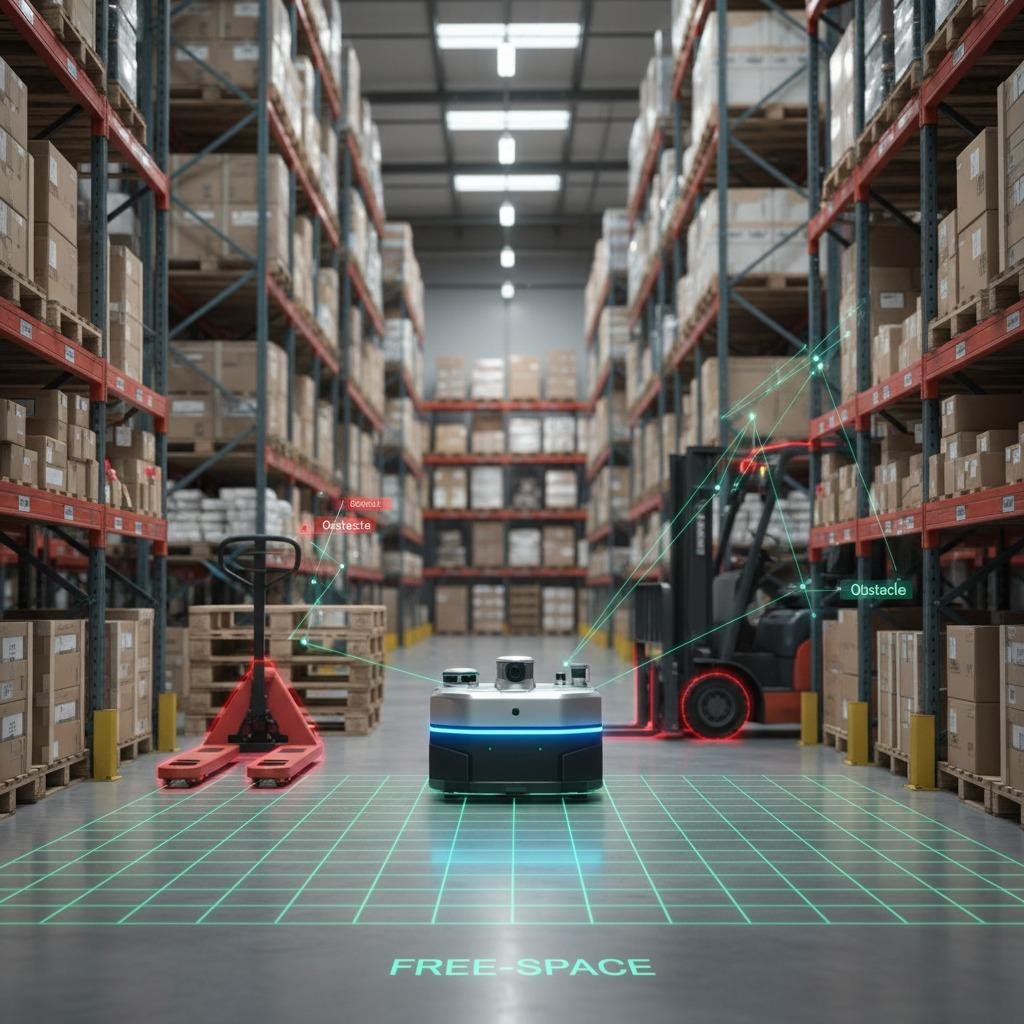
Free-space detection sounds like a software function, but in practice it is a safety and throughput issue. For mobile robots, automated guided vehicles, AMRs, warehouse forklifts, outdoor service platforms, and even advanced driver-assistance stacks, the system has to answer one basic question fast enough to matter: where can the machine move right now?
That question is harder than it looks. A camera sees texture, a lidar sees returns, a radar sees motion, and each sensor can be wrong in its own way. Reflections, dust, partial occlusion, wet floors, transparent objects, stacked pallets, and moving people can all distort the scene. If the machine is too conservative, it slows down and wastes capacity. If it is too optimistic, it risks collision. The best approach is usually not one sensor or one algorithm, but a sensible combination of perception layers that separate open path from occupied space with enough confidence to support motion planning.
What Engineers Usually Need to Decide
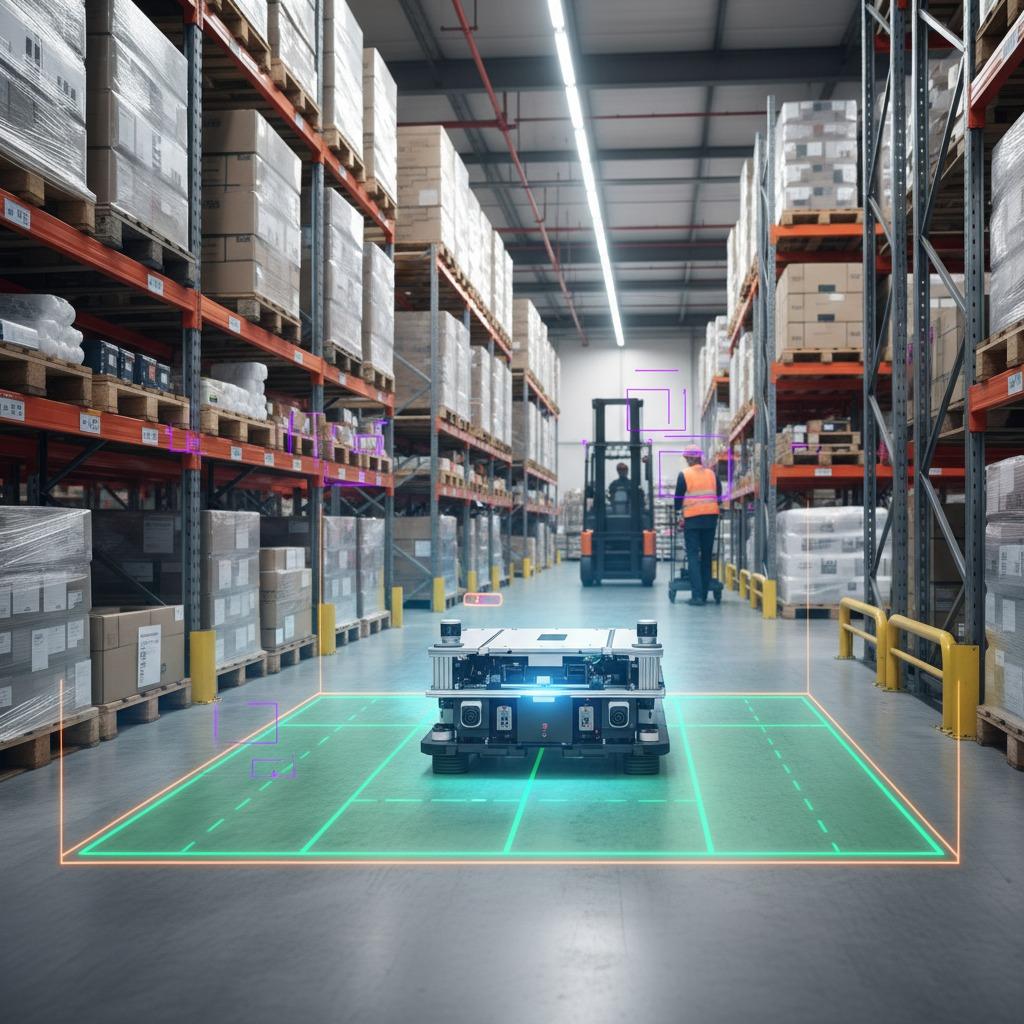
Most buyers are not asking whether free-space detection is possible. They are asking which sensing and mapping approach fits the environment, the speed of the machine, and the acceptable level of uncertainty. In a structured warehouse, simple lane or aisle detection may be enough. In a mixed indoor-outdoor site, the system may need obstacle boundary extraction and a live model of changing surfaces. In crowded spaces, dynamic object mapping becomes just as important as identifying the static background.
That is why free-space detection should be treated as a system decision, not a single software checkbox. The right answer depends on field of view, range, update rate, lighting, compute budget, and how much the controller can tolerate temporary ambiguity.
Quick Comparison of Common Perception Tasks
Static environment modeling
This is the stable layer. It describes walls, racks, curbs, shelves, lane edges, and other features that do not move often. It is useful for route planning and map consistency, especially in repeatable industrial layouts.
Dynamic object mapping
This layer tracks people, vehicles, carts, and other moving objects. It matters because a path that is free one second may be blocked the next. In busy facilities, dynamic object mapping often determines whether the machine can operate smoothly or spends too much time stopping and replanning.
Obstacle boundary extraction
This is the practical edge work. A perception stack may know an object exists, but boundary extraction tells the planner where it starts and ends. That distinction helps with tight maneuvers, docking, and navigation near racks, pallets, or curb lines.
Real-time environmental reconstruction
This is the most demanding version of the problem. The system updates its view continuously, sometimes building a near-live representation of the scene. It is useful when the environment changes frequently or when motion decisions must be made at speed. The tradeoff, of course, is compute load and integration complexity.
Typical Sensor and Software Approaches
There is no universal stack, but several patterns show up repeatedly. Camera-based systems can be effective when texture, color, and lane markings are clear. 2D or 3D lidar is often preferred when geometry matters more than appearance. Radar can help where motion and harsh weather complicate other sensors, though it is not always the best tool for clean spatial boundaries. In many industrial deployments, sensor fusion provides the strongest result because each modality covers another’s weak spots.
On the software side, free-space detection may rely on segmentation, point-cloud processing, occupancy grids, depth inference, or rules built around obstacle height and clearance. The method matters less than the output quality: planners need a reliable distinction between traversable and non-traversable zones, plus enough update speed to avoid stale decisions.
Selection Criteria That Actually Affect Performance
Buyers often focus on range first, but that is only one variable. In real projects, the more useful questions are practical ones. How stable is the detection in poor lighting? Can it handle reflective floor coatings? What happens near glass or mesh? How quickly does the map refresh when a person steps into the path? Does the system preserve useful free-space detection when part of the sensor view is blocked by cargo or machine hardware?
Integration is another quiet issue. A perception stack may look excellent in a demo and still struggle when tied to the vehicle controller, safety layer, or route planner. Engineers should check not only the raw detection quality, but also the latency, interface compatibility, calibration burden, and how easy it is to validate in the actual operating environment.
Common Mistakes in Buying and Deployment
The most common mistake is assuming a clean demo equals production readiness. Lab floors are tidy. Real floors are not. A second mistake is underestimating dynamic clutter. In facilities where carts, forklifts, and operators move unpredictably, static maps quickly become outdated unless the system can keep up.
Another frequent error is overfitting the stack to one site condition. A perception setup tuned for bright indoor aisles may not survive outdoor glare or low-contrast corners. It is usually wiser to test failure modes early: occlusion, temporary blockages, partial sensor loss, and narrow passages.
Practical Buyer Advice
If your team is comparing solutions, ask for evidence in the same kind of environment you will actually run. Request examples of boundary behavior near edges, tight turns, and moving traffic. Look closely at how the system distinguishes a true obstacle from harmless background clutter. For many applications, the best free-space detection system is not the one with the most aggressive claims, but the one that keeps behavior predictable when conditions change.
If the application is safety-critical, bring controls and operations into the discussion early. Perception does not work in isolation; it feeds the motion stack, and the motion stack determines whether a detection result becomes a smooth reroute or a hard stop. That difference matters on the floor, where uptime and operator confidence are both on the line.
A Simple Next Step
Start by defining the operating environment, the expected obstacles, the vehicle speed, and the level of map freshness your application needs. From there, narrow the choice between static environment modeling, dynamic object mapping, and real-time environmental reconstruction, or a hybrid of all three. That framework usually gets teams to a better decision faster than comparing sensor brochures alone.