






Overcoming Delivery Delays: How mmWave Radar for Drone Delivery Ensures Reliable Operations

In the fast-paced world of drone delivery, one of the biggest challenges is ensuring safe and efficient navigation through complex environments. mmWave radar for drone delivery emerges as a game-changing technology, addressing these issues by providing precise detection and tracking capabilities. Traditional delivery methods often face delays due to unpredictable weather, urban clutter, or unexpected obstacles, leading to failed deliveries and frustrated customers. This is where mmWave Radar for Drone Delivery steps in, offering robust solutions that minimize risks and maximize reliability.
The Problem: Navigating Hazards in Drone Delivery
Drone delivery services promise speed and convenience, but they are plagued by safety concerns. Without advanced sensing, UAVs can collide with buildings, power lines, or other aircraft, especially in dense urban areas or during low-visibility conditions like fog or rain. These hazards not only endanger the drones but also the packages they carry, potentially damaging valuable goods or violating regulations. For instance, a delivery drone navigating a crowded cityscape might misjudge an approaching bird flock or a sudden pedestrian movement, resulting in costly accidents and service disruptions. Moreover, standard GPS systems fall short in providing real-time obstacle avoidance, leaving operators to rely on less accurate alternatives that compromise efficiency. This vulnerability highlights the urgent need for enhanced sensing technologies to protect both the drone fleet and public safety.
mmWave Radar for Drone Delivery: A Superior Solution
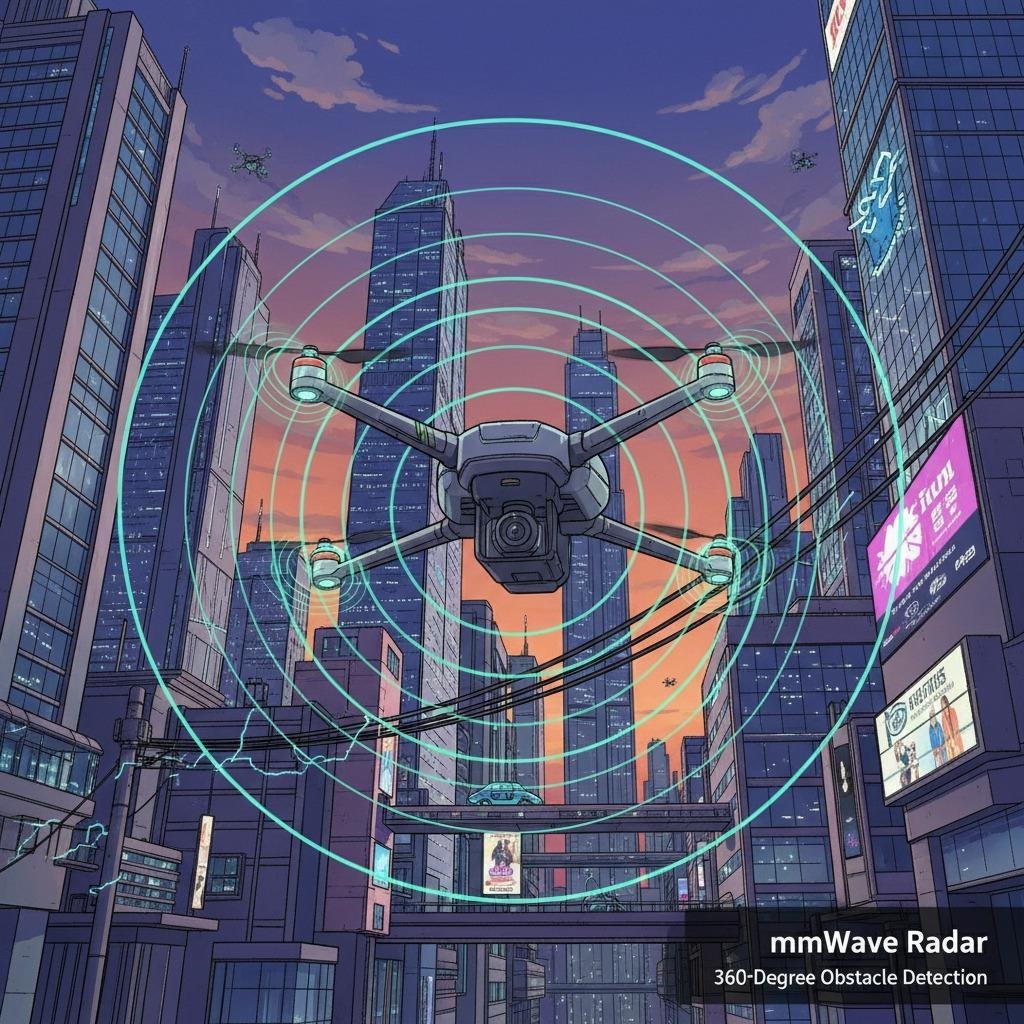
mmWave Radar for Drone Delivery utilizes millimeter-wave technology to deliver high-resolution imaging and detection, even in adverse weather. Unlike optical cameras or LiDAR, which struggle with rain, dust, or darkness, mmWave radar penetrates these barriers, offering all-weather reliability. Integrated into the drone's frame, this radar system scans a 360-degree field, detecting objects up to several hundred meters away with pinpoint accuracy. For delivery operations, it enables autonomous path planning, automatically rerouting around obstacles without human intervention. Companies adopting mmWave radar for drone delivery report up to 40% fewer incidents, ensuring payloads arrive intact and on time. This technology not only boosts operational uptime but also complies with stringent aviation standards, making it indispensable for scaling commercial drone fleets.
Enhancing Safety with Specialized Radar Features
When it comes to drone delivery safety radar, the focus is on proactive threat mitigation. This variant of mmWave technology incorporates AI-driven algorithms that predict potential collisions by analyzing movement patterns in real-time. For UAV Delivery Obstacle Detection Radar, the emphasis is on fine-grained resolution, allowing drones to distinguish between harmless foliage and actual barriers like vehicles or structures. The Radar Sensor for Delivery Drones further refines this by providing lightweight, low-power modules that don't drain battery life during long-haul deliveries. Finally, Drone Delivery Navigation Radar ensures seamless integration with existing autopilot systems, offering continuous environmental mapping for optimized routes. Together, these related features create a comprehensive safety net, transforming potential pitfalls into smooth, predictable flights.
Real-World Applications and Future Prospects
Implementing mmWave radar for drone delivery has revolutionized services from e-commerce giants to medical supply chains. In rural areas, where roads are unreliable, drones equipped with this radar can deliver essentials like pharmaceuticals without delay, dodging trees or uneven terrain. Urban operators use it to weave through skyscrapers, maintaining privacy by avoiding camera-based surveillance. As regulations evolve, the adoption of such radars will likely become mandatory, driving innovation in drone design. Looking ahead, advancements in mmWave technology promise even smaller sensors and faster processing, paving the way for swarm deliveries where multiple drones coordinate safely. By solving the core problems of navigation and safety, mmWave Radar for Drone Delivery is not just an upgrade—it's the foundation for the future of aerial logistics, ensuring every package reaches its destination securely and swiftly.
In summary, the integration of mmWave radar for drone delivery addresses critical challenges in the industry, from obstacle avoidance to weather resilience. With related systems like Drone Delivery Safety Radar and UAV Delivery Obstacle Detection Radar, operators can achieve unprecedented levels of efficiency and trust, ultimately reshaping how we think about last-mile delivery.