






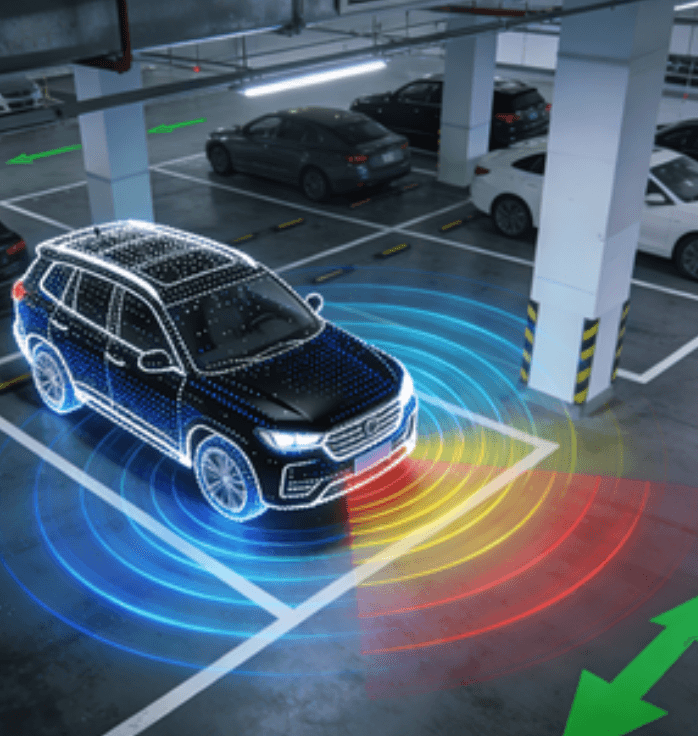
Redefining the Safety Boundaries of Automated Parking with Intelligent mmWave Radar
In the evolution of autonomous driving, Automated Parking Assistance (APA) systems are undergoing a fundamental transformation—from a convenience-oriented feature to a safety-critical capability. As SAE L3 and even L4 autonomous driving functions are gradually rolled out, parking scenarios such as narrow garages, unpredictable lighting, and dynamic obstacles impose near-stringent requirements on perception reliability.
This article explores how intelligent mmWave radar, combining physical advantages with algorithmic innovation, overcomes the limitations of traditional ultrasonic and vision-based approaches and becomes a core perception pillar for advanced automated parking.
I. Why Traditional Parking Perception Architectures Are Reaching Their Limits
Early automated parking systems primarily relied on ultrasonic sensors (USS) and surround-view cameras (SVM). However, as systems move toward full-scenario automation, the physical constraints of this architecture are increasingly exposed.
1. Ultrasonic Sensors: Short Range and Limited Semantics
Ultrasonic sensors rely on acoustic waves whose effective detection range is typically below five meters due to air attenuation. Vehicles must therefore move at extremely low speeds to complete space scanning.
More importantly, ultrasonic sensors lack object classification capability. They cannot reliably distinguish curbs, parking locks, or pedestrians and are highly sensitive to weather conditions or surface contamination, leading to frequent false alarms.
2. Vision-Based Systems Under Adverse Conditions
Cameras provide strong semantic understanding, such as recognizing parking lines and signage. However, image quality degrades significantly in low-light garages, under strong glare, or in rain and fog.
Depth estimation based on monocular or fisheye cameras also loses accuracy at longer distances. This makes it difficult to deliver reliable 360-degree safety redundancy—posing a major risk in unattended valet parking scenarios.
II. Intelligent mmWave Radar: From Supporting Sensor to Core Perception
To address these challenges, intelligent mmWave radar is extending from driving scenarios into parking applications, offering decisive advantages in robustness and range.
1. A Step Change in Perception Range
Compared with ultrasonic sensors, mmWave radar extends detection range by five to ten times. This enables early identification of available parking spaces and trajectory planning tens of meters in advance, supporting emerging Direct-to-Park user experiences.
Vehicles no longer need to pass a parking space and reverse back, significantly improving parking efficiency and user comfort.
2. True All-Weather Robustness
Operating at 77 GHz and 79 GHz, mmWave radar maintains stable ranging and velocity measurement regardless of darkness, heavy rain, or sensor contamination. This reliability forms the foundation of safety-critical automated parking systems.
III. Technology Enablers: 4D Imaging and AI-Driven Radar Intelligence
The impact of mmWave radar goes beyond hardware—it is driven by advances in signal processing and perception algorithms.
1. 4D Imaging and Vertical Resolution
Conventional “3D radar” lacks height information, making it difficult to distinguish between ground-level obstacles and overhead structures.
Modern intelligent radar introduces vertical resolution, forming 4D imaging radar. With customized hardware such as 3D waveguide antenna arrays, these systems generate high-density point cloud data, enabling accurate three-dimensional environment reconstruction.
This capability significantly reduces risks such as underbody scraping or collisions with suspended obstacles.
2. AI and Machine Learning Integration
Leading solutions embed deep learning directly into radar processing pipelines.
By analyzing micro-Doppler signatures, AI algorithms can classify pedestrians, cyclists, stationary vehicles, and structural elements. In complex parking environments with severe multipath reflections, machine learning filters false targets and maintains stable tracking of partially occluded objects.
3. Sensor Fusion with Satellite Architecture
To optimize system-level compute efficiency, the industry is increasingly adopting satellite architecture designs. Radar sensors transmit raw data to a central domain controller, where long-range radar perception is fused with camera-based semantic understanding.
The result is a 360-degree, blind-spot-free digital twin of the parking environment.
IV. Key Parking Applications Enabled by mmWave Radar
1. Automated Parking Assistance (APA)
In SAE L2 systems, mmWave radar acts as a safety guardian, detecting dynamic vehicles and pedestrians early and ensuring smooth parking maneuvers in mixed-traffic environments.
2. Home Parking Pilot (HPP)
HPP requires autonomous navigation over the final 500 meters without GPS or HD maps.
Radar supports SLAM by identifying stable features such as pillars and walls. Radar-based maps are inherently robust to lighting changes, offering higher long-term stability than vision-only solutions.
3. Autonomous Valet Parking (AVP)
In SAE L4 AVP scenarios, drivers can exit the vehicle at the drop-off zone. With perception ranges exceeding 100 meters, mmWave radar provides sufficient reaction time to safely handle unexpected dynamic obstacles.
4. Radar-Enhanced 3D Surround View
By overlaying radar-derived obstacle distances onto surround-view images, the system mitigates visual distortion and provides centimeter-level accuracy for low-speed maneuvers.
V. Future Outlook: How Parking Perception Will Evolve
Three trends will shape the next generation of automated parking perception:
-
Multi-Band Complementarity:
mmWave radar will integrate with UWB for ultra-close-range detection, fully replacing large ultrasonic sensor arrays. -
Software-Defined Radar:
Centralized compute platforms enable continuous OTA-driven radar performance improvements, including better detection of small obstacles. -
System-Level Safety Redundancy:
Sensor fusion will evolve from functional stacking to physics-based safety complementarity across radar, cameras, and ultrasonics.
Conclusion
Intelligent mmWave radar is not merely an incremental upgrade—it is a foundational technology on the path to fully autonomous parking and driving. By addressing perception challenges in real-world environments, it elevates automated parking systems to a truly safety-critical level.
For global OEMs, building a perception architecture centered on intelligent radar is no longer optional. It is a necessary step toward safe, scalable, and future-proof intelligent mobility.