






Why Inter-Band Coexistence Has Become a Real Design Problem
The Inter-band coexistence mechanism is no longer a niche RF topic. As products move across crowded and sometimes overlapping spectrum blocks, engineers are being asked to make multiple radios, sensors, and detection functions share the same platform without tripping over one another. That matters in automotive, industrial sensing, consumer electronics, and connected infrastructure, where one bad interaction can mean lost range, false detections, unstable links, or a system that fails regulatory testing later than anyone wants.
The practical issue is not simply interference in the abstract. It is what happens when a device is expected to sense, transmit, and adapt across bands with different propagation characteristics, different antenna behavior, and different regulatory expectations. A design that looks fine on a block diagram can behave very differently once the enclosure, nearby metals, antenna placement, and operating modes are all in the real world. That is why coexistence has to be designed, not hoped for.
What the Mechanism Is Trying to Solve
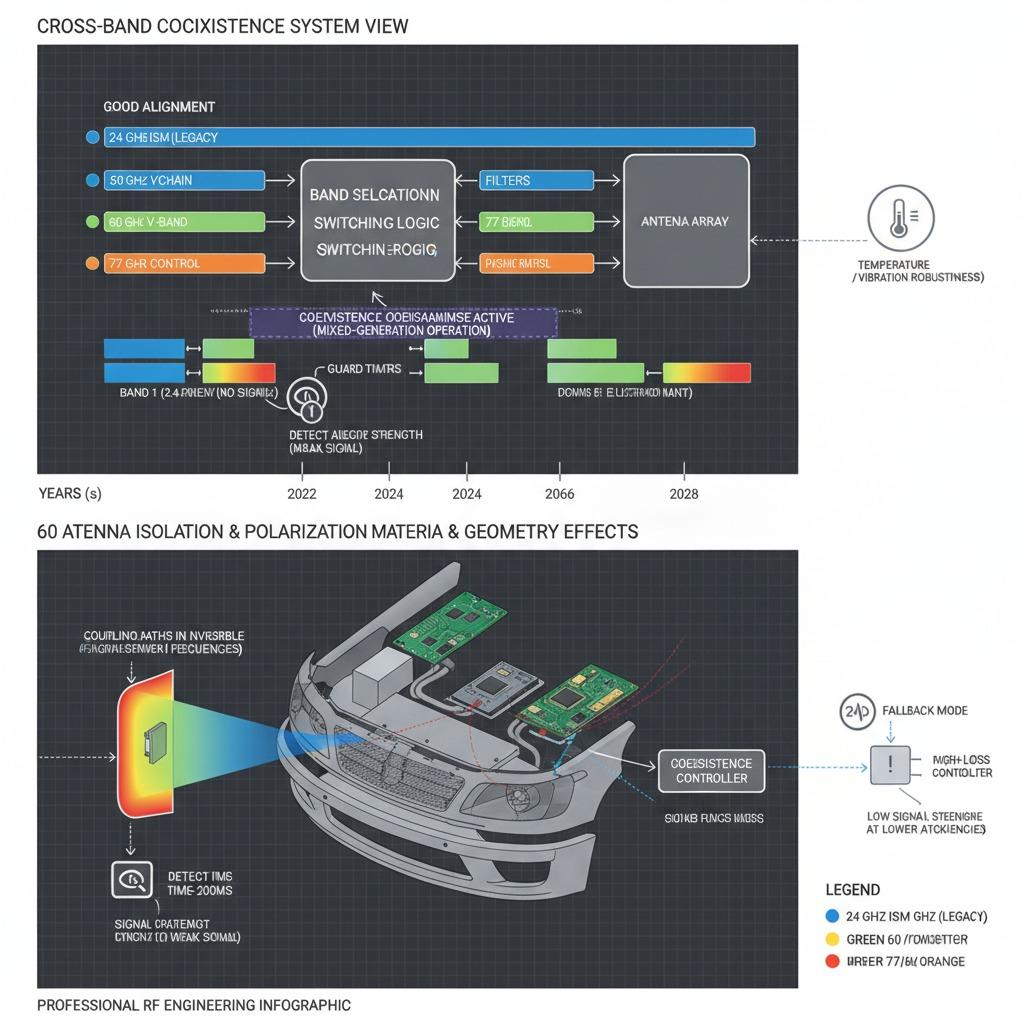
At a basic level, an inter-band coexistence mechanism coordinates activity across two or more frequency bands so they do not degrade one another. That coordination may involve filtering, scheduling, guard times, power control, antenna isolation, adaptive channel selection, or a sensing-and-switching logic layer. The right mix depends on the application, but the objective is always similar: preserve function in one band while another band is active or nearby.
This becomes especially relevant when a system uses Spectrum sensing for dynamic access. If a device can detect which band is usable at a given moment, it can shift operation away from congestion or interference. That sounds straightforward, but in practice the sensing threshold, reaction time, and false-alarm rate all matter. Too conservative, and the device avoids usable spectrum. Too aggressive, and it collides with other users or with its own subsystems.
Key Application Scenarios Where Coexistence Decisions Matter
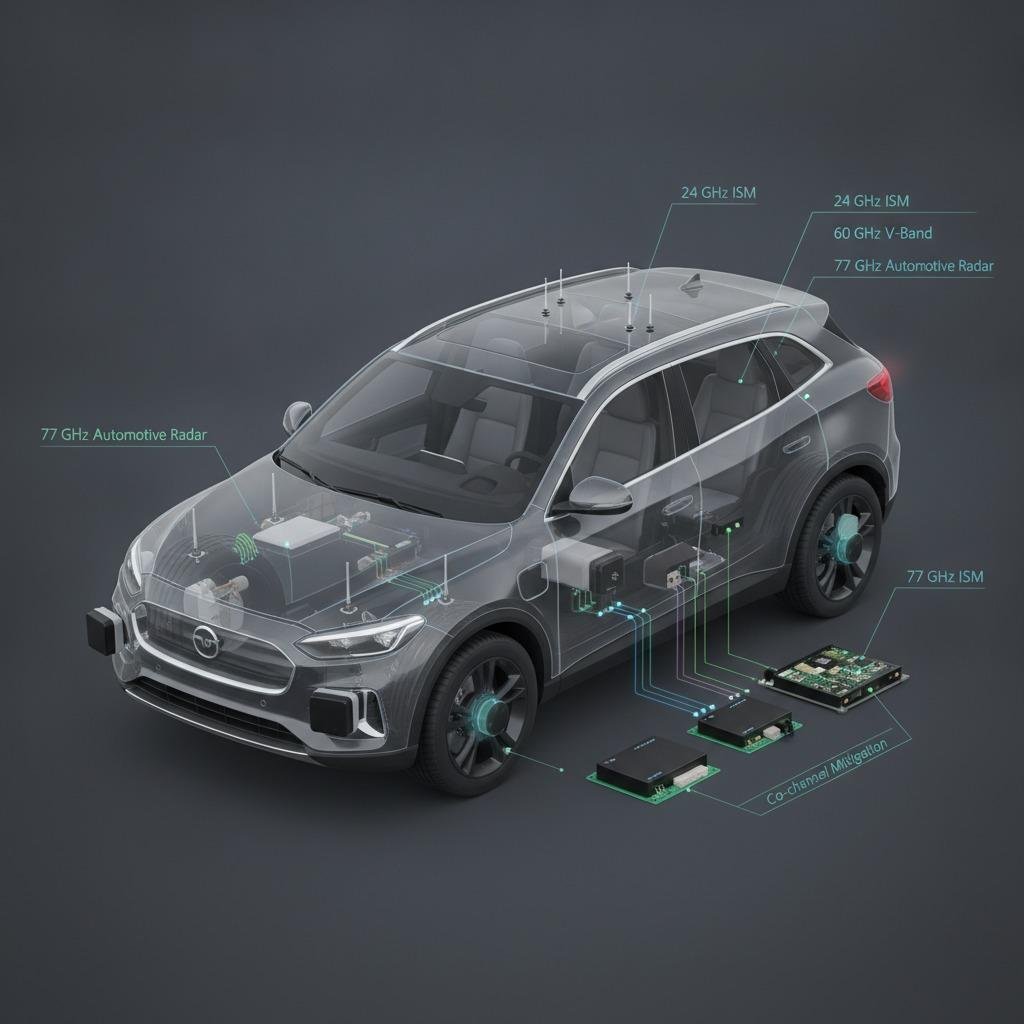
One visible example is 77 GHz automotive radar migration. Vehicle platforms increasingly rely on radar for corner cases that cameras and ultrasonic sensors handle less well. As architectures change, designers may need to coordinate radar modules with other wireless functions, nearby control electronics, and the packaging constraints of modern vehicles. A coexistence strategy here is not just about performance; it is about keeping sensing stable across temperature, vibration, and changing electromagnetic conditions.
Another common case is 60 GHz V-band sensing, where short-range high-resolution detection can be very useful but the propagation environment is unforgiving. At 60 GHz, even small changes in orientation, material choice, or enclosure geometry can shift performance. If another band shares the same platform, the coexistence plan needs to account for coupling paths that would be invisible at lower frequencies.
There is also still a place for 24 GHz ISM band operation in legacy and transitional designs. Some products continue to use 24 GHz functions because the platform already supports them or because the application does not require the higher-frequency profile of newer systems. The challenge is that legacy and newer bands may need to coexist during a migration period, and that is where engineering discipline pays off. Mixed-generation platforms are often the ones that expose weak assumptions.
Quick Reference: What a Good Coexistence Strategy Usually Includes
There is no universal recipe, but most workable designs combine several of the following:
- Band-aware sensing or monitoring logic
- Frequency planning that avoids obvious overlap and harmonics
- Time-domain scheduling when simultaneous activity is risky
- Filtering and shielding to reduce self-interference
- Antenna spacing and polarization choices that lower coupling
- Fallback modes when a preferred band is unavailable
In other words, coexistence is a systems task. It rarely fails because of one dramatic mistake. More often it fails because five small compromises line up in the wrong direction.
Selection Criteria Engineers Should Pressure-Test Early
If you are evaluating a platform, module, or subsystem that claims coexistence capability, ask how the mechanism behaves under real load, not only in a lab demo. Does it still work when another radio is active at the same time? How quickly does it respond to spectral changes? What is the behavior when sensing is noisy or partly blocked by packaging? These are not academic questions. They decide whether the feature is robust or merely present on paper.
For product teams, the first decision is often whether the system needs proactive coordination or reactive avoidance. Proactive approaches may cost more in design effort, but they usually give more predictable performance. Reactive approaches can be lighter to implement, though they may suffer when the environment changes faster than the control loop can keep up. That tradeoff is especially important in dynamic access scenarios.
Common Mistakes That Show Up Late
One mistake is treating different bands as if they were just different labels on the same behavior. They are not. A sensor optimized for one band can be almost blind in another once antenna effects, material absorption, and atmospheric losses are taken into account. Another mistake is underestimating platform-level coupling. A module might pass bench tests and still fail once installed next to a display, inverter, motor controller, or dense cable harness.
There is also a tendency to overtrust the sensing layer alone. Spectrum sensing for dynamic access is useful, but it does not replace careful RF architecture. If the underlying isolation is poor, sensing becomes a bandage rather than a solution.
Practical Buyer Advice for Sourcing and Product Teams
When comparing supplier options or internal design paths, ask for a plain explanation of the coexistence mechanism in the context of your actual use case. A useful answer should cover when the system senses, when it switches, what happens if a band is occupied, and how degraded conditions are handled. If the discussion stays at the feature-name level, keep pressing.
It also helps to map the coexistence problem against lifecycle plans. A platform that works for one band today may need to absorb a second or third band later. If the architecture is rigid, migration costs can rise quickly. That is particularly true for programs moving between 24 GHz ISM band operation, 60 GHz V-band sensing, and 77 GHz automotive radar migration paths. The parts may not share much in common beyond the fact that they all live in the RF world, which is precisely why planning matters.
FAQ: A Few Questions That Come Up Often
Is coexistence only about avoiding interference?
No. It is also about maintaining timing, accuracy, and predictable behavior when multiple bands or functions share a platform.
Does dynamic access solve the problem by itself?
Not usually. Dynamic access helps, but it still depends on sensor quality, response logic, and the underlying RF layout.
Should legacy and new bands be designed separately?
Usually they should be evaluated separately first, then together. That sequence catches more issues than assuming the combined system will behave as expected.
A Clear Next Step
If you are planning a new platform or managing a migration, start by documenting which bands must coexist, which functions are mission-critical, and what failure looks like in the field. From there, test the isolation, sensing, and switching logic against the actual enclosure and operating scenarios, not only an idealized schematic. That one step often reveals whether the Inter-band coexistence mechanism is a real design asset or just a line item in the architecture review.