






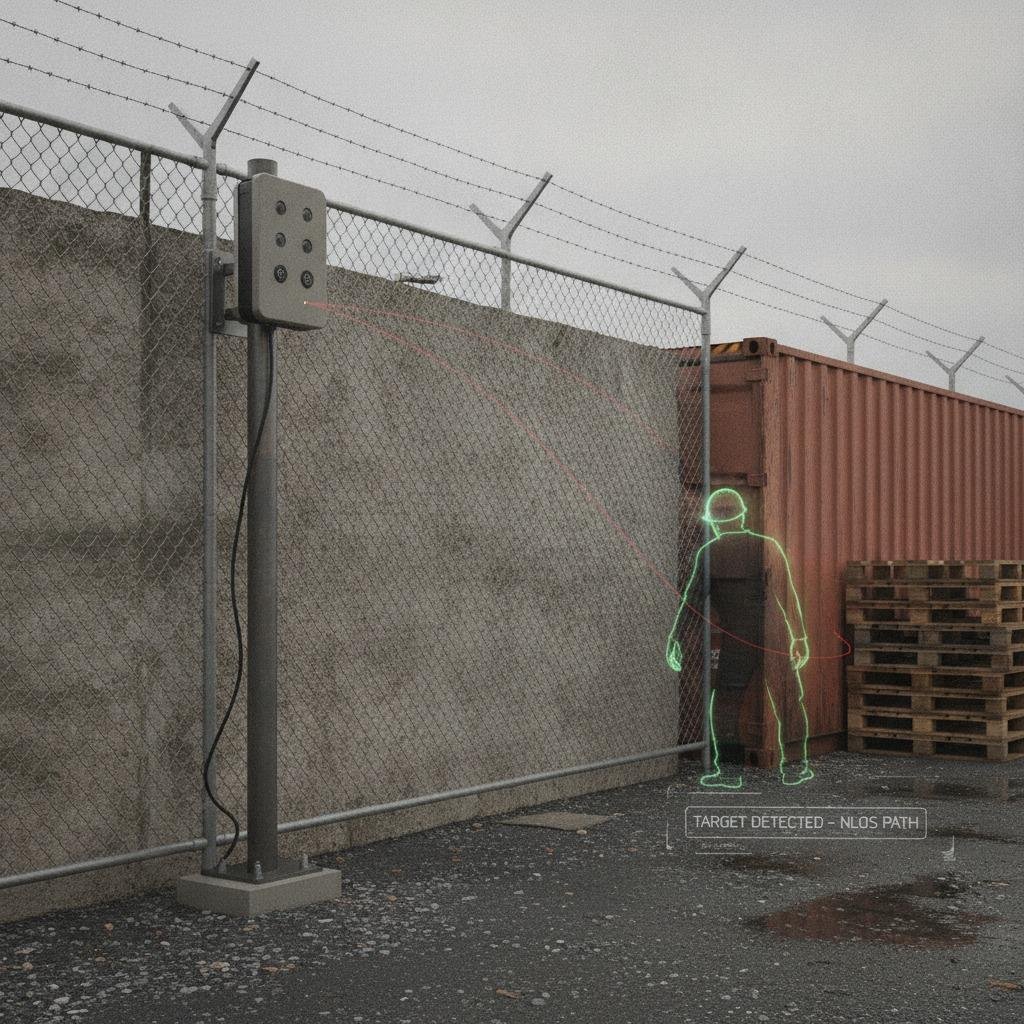
Why non-line-of-sight sensing is moving from research topic to buying decision
Non-line-of-sight (NLOS) sensing is no longer just a lab phrase for radar teams and perception researchers. It is becoming a practical requirement in applications where the object of interest is not directly visible, the environment is crowded, or the signal path is constantly being broken up by walls, vehicles, machinery, weather, or terrain. For engineers and sourcing managers, the question is not whether NLOS sensing sounds impressive. It is whether the sensor stack can still deliver usable data when the obvious line of sight disappears.
That matters because real industrial sites rarely offer clean conditions. Warehouses have stacked inventory and metal shelving. Ports have cranes, containers, and spray. Mining and construction sites throw up dust, rain, and moving debris. Automotive and robotics applications face partial occlusion, complex reflections, and low-contrast targets. A sensor that works only in ideal conditions can look strong on a spec sheet and then fail at the exact moment it is needed.

The core challenge: seeing through clutter without trusting every reflection
The practical problem behind NLOS sensing is not simply detection. It is deciding which returns belong to the target, which are just background, and which are misleading multipath artifacts. In dense environments, reflected energy can arrive from several paths at once. Some of those paths are useful clues, but others distort range, angle, or object shape. If your system cannot separate them well enough, the result is false alarms, missed detections, or unstable tracking.
This is where related methods such as ground clutter filtering and multipath mitigation become central rather than optional. Ground clutter filtering helps suppress stationary or slowly varying returns from the floor, terrain, or nearby structures. Multipath mitigation is aimed at reducing the damage caused when a signal bounces off surfaces before reaching the receiver. Neither technique is magic, and neither should be treated as a software afterthought. In practice, they shape the whole sensing architecture.
What buyers should compare first
When evaluating systems for NLOS sensing, the most useful comparison is often not a headline range number. It is how the sensor behaves under realistic noise and obstruction. Three questions usually matter most.
How well does it handle low SNR target detection?
Low SNR target detection is a make-or-break requirement in blocked or partially hidden scenes. If the target return is weak compared with background noise, the system needs enough sensitivity and signal processing discipline to preserve it without flooding the output with false positives. Buyers should ask how the platform handles weak targets near large reflectors, moving machinery, or dense structural clutter.
How does it behave in bad weather?
Rain and fog robustness is not just a nice-to-have for outdoor deployments. Weather changes attenuation, scattering, and background noise, which can alter detection reliability and confidence. A sensor family that performs well in a dry test bay may behave differently once the environment turns wet, cold, or low-visibility. For field equipment, that difference can affect uptime and safety decisions.
What assumptions does the algorithm make?
Some systems lean heavily on environment-specific tuning. That can work well in a fixed installation, but it becomes a problem when the scene changes. Ask whether the sensing stack depends on tightly controlled geometry, or whether it can adapt to changing surfaces, target motion, and occlusion patterns. If the vendor cannot explain the failure modes in plain language, that is a warning sign.
Where NLOS sensing tends to work best
There is no single sensor type that solves every blocked-view problem. Different use cases favor different tradeoffs. In industrial automation, NLOS sensing can help detect assets around corners or behind temporary obstructions. In autonomous mobility, it can improve awareness of hidden traffic participants, though the system still needs careful validation before it is trusted in safety-critical functions. In perimeter monitoring, it can extend awareness beyond a direct visual path, but it should be paired with sensible placement and layered sensing, not used as a standalone promise.
A useful rule of thumb: the more variable the environment, the more important it is to look at robustness rather than peak performance. A system that is slightly less aggressive but more stable under clutter may be the better buy.
Common buying mistakes that cause trouble later
One common mistake is selecting a platform based on a single best-case demo. Another is assuming that better raw sensitivity automatically means better field performance. In cluttered environments, a very sensitive sensor can also be very eager to report reflections that do not matter.
A second mistake is underestimating integration work. NLOS sensing often depends on downstream signal processing, placement strategy, calibration, and environmental assumptions. If the installation team does not understand those dependencies, even a strong product can underperform.
Finally, do not overlook maintenance and drift. Real sites change. Walls get added, pallets move, moisture rises, dust accumulates. The sensor may be the same, but the scene is not.
Practical selection advice for engineers and sourcing teams
For engineers, the decision starts with scene mapping: what blocks the target, what reflects the signal, and what level of false alarm is acceptable. For sourcing managers, the focus should be on repeatability, environmental tolerance, and how much integration support the supplier can realistically provide. Ask for application-relevant demonstrations, not just lab plots.
If the project depends on low SNR target detection, ask for examples with weak targets near clutter. If weather exposure is part of the job, request evidence of rain and fog robustness in conditions similar to the deployment site. If the scene is full of reflections, insist on a clear explanation of the system’s multipath mitigation approach and how ground clutter filtering is handled.
It is also worth checking whether the system is meant to complement other sensors or replace them. In many deployments, the best answer is a layered one. NLOS sensing adds capability, but it rarely eliminates the need for good placement and sensible sensor fusion.
FAQ: questions that come up during procurement
Is NLOS sensing always better than traditional sensing?
No. It is better for certain problem scenes. If you have clear line of sight and stable conditions, simpler sensing may be cheaper and easier to validate.
Can software solve every occlusion problem?
Not reliably. Algorithms help a great deal, but the physics of blockage, reflection, and scattering still sets the limits.
Should we prioritize range or robustness?
For many field deployments, robustness wins. A sensor that performs well only in clean conditions can become a liability once the site gets messy.
Next step
If you are evaluating NLOS sensing for a new project, build your shortlist around real scene conditions rather than brochure claims. Start with the clutter, the weather, the mounting constraints, and the failure modes. That usually leads to a better decision than chasing the longest range number on paper.