







Overcoming traffic congestion challenges using millimeter-wave radar technology
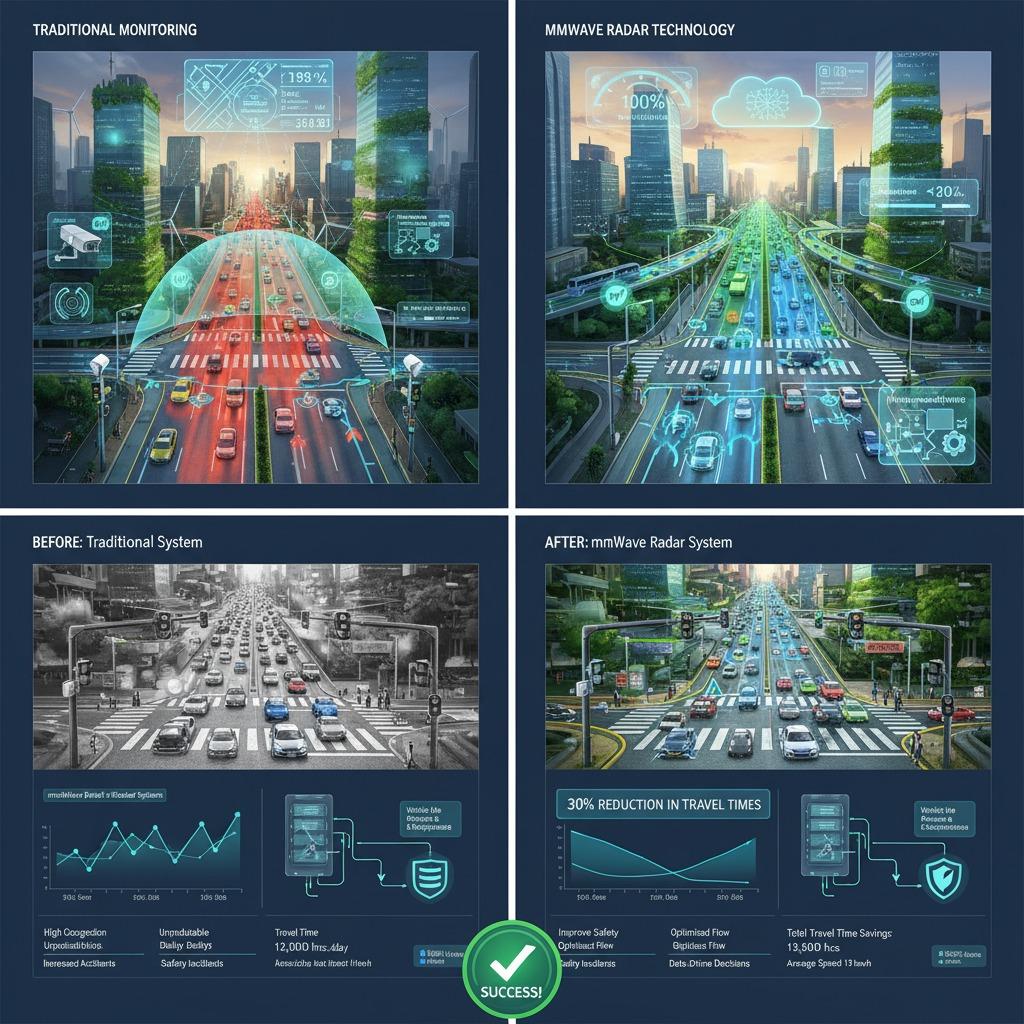
Traffic congestion remains one of the most pressing problems in busy urban traffic, leading to longer commutes, increased fuel consumption, and a heightened risk of accidents. Millimeter-wave radar technology has emerged as a revolutionary solution, providing accurate and reliable detection capabilities even in adverse weather conditions. This advanced sensor technology uses millimeter waves to monitor vehicle movement, providing real-time data that traditional systems often struggle to accurately acquire. By integrating millimeter-wave radar sensors into infrastructure, cities can address these problems head-on, creating smarter and safer roads.
The core problem of traditional traffic monitoring
Traditional traffic monitoring solutions rely heavily on cameras or induction coils, but these solutions have many limitations. Cameras struggle to function properly in adverse environments such as low light, fog, or rain, often resulting in incomplete millimeter-wave traffic flow analysis data. Induction coils buried in roads are expensive to install and maintain, and cannot effectively distinguish vehicle type and speed. These shortcomings lead to inefficient intelligent traffic management, leaving management departments without the information needed for timely intervention. For example, without accurate millimeter-wave radar vehicle detection, sudden traffic congestion cannot be handled promptly, exacerbating urban traffic congestion and environmental impacts.
How can millimeter-wave radar applications solve these problems?
Millimeter-wave radar applications are revolutionizing traffic monitoring by providing all-weather, high-precision detection capabilities. Unlike optical systems, millimeter-wave radar sensors can penetrate rain, snow, and darkness, ensuring uninterrupted, advanced traffic monitoring. In vehicle detection millimeter-wave radar systems, these sensors not only identify vehicle presence but also determine vehicle size, speed, and direction with astonishing accuracy. This data is fed into radar-based traffic systems, enabling intelligent transportation systems to dynamically optimize traffic light timings. For example, during peak hours, millimeter-wave radar technology can detect forming queues and adjust traffic lights to improve traffic flow, fundamentally addressing traffic congestion.
Applying millimeter waves to traffic flow analysis in smart cities
To fully leverage the advantages of millimeter-wave traffic flow analysis technology, integration with artificial intelligence platforms is crucial. Imagine highways equipped with millimeter-wave radar sensors continuously scanning lanes and transmitting data to a central system for real-time analysis. This approach supports comprehensive traffic monitoring solutions, encompassing everything from vehicle counting to congestion pattern prediction. Cities adopting such radar-based traffic systems report travel times reduced by up to 30% due to proactive intelligent traffic management. Furthermore, these systems can quickly identify abnormal driving or accidents and alert emergency responders at unprecedented speeds, thereby enhancing safety.
Enhancing the safety and compliance of intelligent transportation systems
Beyond improving efficiency, millimeter-wave radar technology can also enhance the safety of intelligent transportation systems. Combined with license plate recognition technology, it helps enforce regulations such as speed limits and high-occupancy vehicle (HOV) lane usage. In busy traffic areas, advanced millimeter-wave-driven traffic monitoring technology can ensure compliance with traffic rules without intrusive measures, thereby reducing violations and improving overall road order. This holistic solution not only addresses immediate traffic problems but also promotes long-term urban planning; data from millimeter-wave radar applications can guide infrastructure upgrades.
Millimeter wave innovation is leading the future of urban transportation.
Looking ahead, the application of millimeter-wave radar technology promises to revolutionize the way we manage traffic. As cities grow, the demand for reliable traffic monitoring solutions will increase, and the versatility of millimeter-wave technology makes it a cornerstone of future systems. From integration with autonomous vehicles to supporting environmentally friendly route planning, this technology is driving sustainable development. By using precise and reliable tools, such as millimeter-wave vehicle detection radar and millimeter-wave traffic flow analysis radar, to overcome the drawbacks of outdated methods, we can envision a future where cities are no longer congested, but instead offer a seamless, intelligent travel experience.