






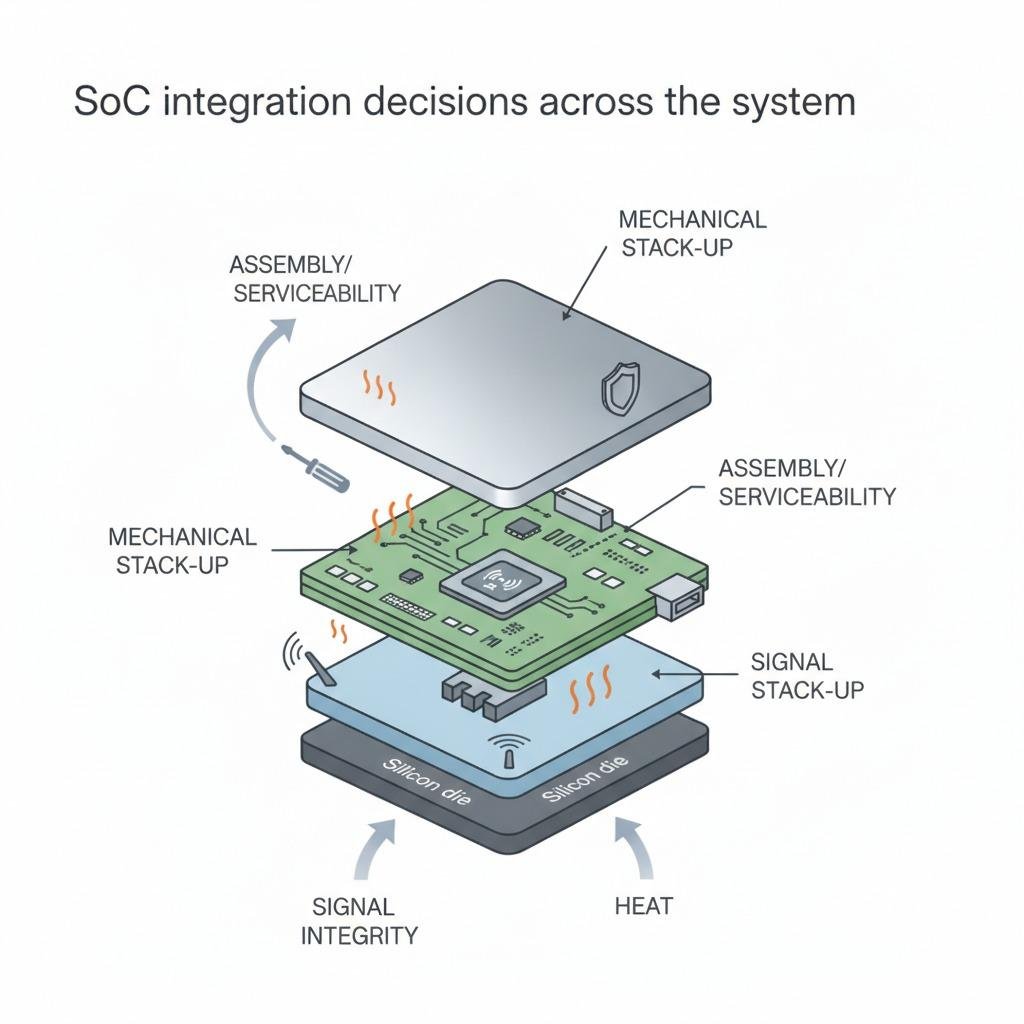
Why System-on-chip (SoC) integration has become a board-level decision, not just a silicon one
System-on-chip (SoC) integration is no longer only about shrinking a design onto one die. For many engineering teams, it now decides whether a product can meet size targets, survive the thermal load of a sealed enclosure, and still leave enough room for power, antennas, connectors, or shielding. That matters most when the brief calls for a compact form factor without giving up performance. In practice, the discussion often starts with silicon and ends with packaging, thermal paths, and the realities of assembly.

That is especially true in sensing and connected hardware, where an embedded radar module may need to sit close to other electronics, metalwork, or a battery pack. The more functions you push into one device, the more you have to think about heat, signal integrity, and mechanical stack-up. So the buying decision is rarely “which chip is best?” It is more often “which integration level can we support without creating a maintenance problem later?”
What SoC integration solves, and what it can quietly complicate
The obvious benefit is consolidation. Fewer discrete components can mean lower assembly complexity, less board space, and fewer interconnect points to inspect. That often supports weight-optimized packaging too, which is valuable in portable equipment, mobile systems, and any product where every gram and cubic millimeter has a cost.
But integration is not free. When more functions sit in one package, thermal density rises. A design that looked elegant in CAD can become difficult to cool once the enclosure is closed and the system is operating in a warm ambient environment. Thermal management for miniaturization is not a side issue; it is often the hidden constraint that decides whether a promising concept becomes a durable product.
Quick reference: where integration usually helps most
Best fit scenarios
SoC-heavy designs tend to make sense when the product needs high functional density, limited board area, or reduced assembly complexity. They are often attractive in sensing devices, communications hardware, compact industrial electronics, and battery-powered systems where component count affects reliability.
Situations that deserve caution
If the application runs hot, sits in an enclosed metal housing, or must support future feature expansion, a more integrated approach can become restrictive. You may save space now but lose flexibility later. That trade-off is not always visible in the early design review, which is why it deserves a frank check before tooling starts.
Design factors engineers should review before committing
Start with heat. Ask where the energy goes, how it leaves the package, and what happens during peak load rather than nominal operation. Miniaturization often pushes components closer together, but closer placement also makes hot spots harder to dissipate. If the thermal path is weak, the rest of the design will inherit the problem.
Next, look at packaging. Weight-optimized packaging is useful only if it still protects the device through assembly, transport, and real field use. Lightweight does not automatically mean robust. A slim enclosure that saves mass but forces awkward rework or poor service access can cost more over the product life cycle than a slightly larger design.
Also consider how much subsystem separation you really need. In some products, radar, processing, and power management can live together cleanly. In others, isolation is more important than density. That is where an embedded radar module, for example, may need careful placement and shielding strategy rather than brute-force integration.
Common mistakes when teams chase miniaturization too early
One common mistake is treating the chip selection as the whole solution. The package, PCB stack-up, thermal interface materials, and enclosure design matter just as much. Another is assuming the smallest option is automatically the most economical. It may reduce part count, yet increase thermal engineering effort or complicate serviceability.
A more subtle mistake is locking in the product architecture before testing heat rise and mechanical behavior under real duty cycles. Prototype boards can look fine on a bench and fail once airflow is reduced or a cover is added. That is a buyer-facing warning worth remembering: if the supplier’s pitch focuses only on features, ask how the design behaves after enclosure closure.
Practical buyer advice for sourcing and product teams
When evaluating SoC-based solutions, ask vendors for the full system view: power draw, thermal expectations, board area assumptions, and any limitations on expansion or rework. Request enough detail to judge whether the product supports your mechanical constraints, not just your performance target.
If your application involves compact form factor goals, press for samples or design examples that show how integration was handled in a real enclosure. If the answer is vague, that usually means the hard work has been pushed onto your team. Sometimes that is acceptable, but it should be a conscious choice.
What a good next step looks like
For teams balancing function, space, and heat, the most useful move is to review the intended product architecture before finalizing component selection. That means checking how much integration is genuinely needed, where thermal risk sits, and whether the mechanical package can support the electronics over the full operating range.
If you are sourcing an SoC-based module or planning a new embedded platform, build the conversation around system fit, not just silicon specs. The right answer is usually the one that keeps performance stable once the product leaves the lab and enters a real enclosure, with real constraints, and a real production schedule.