





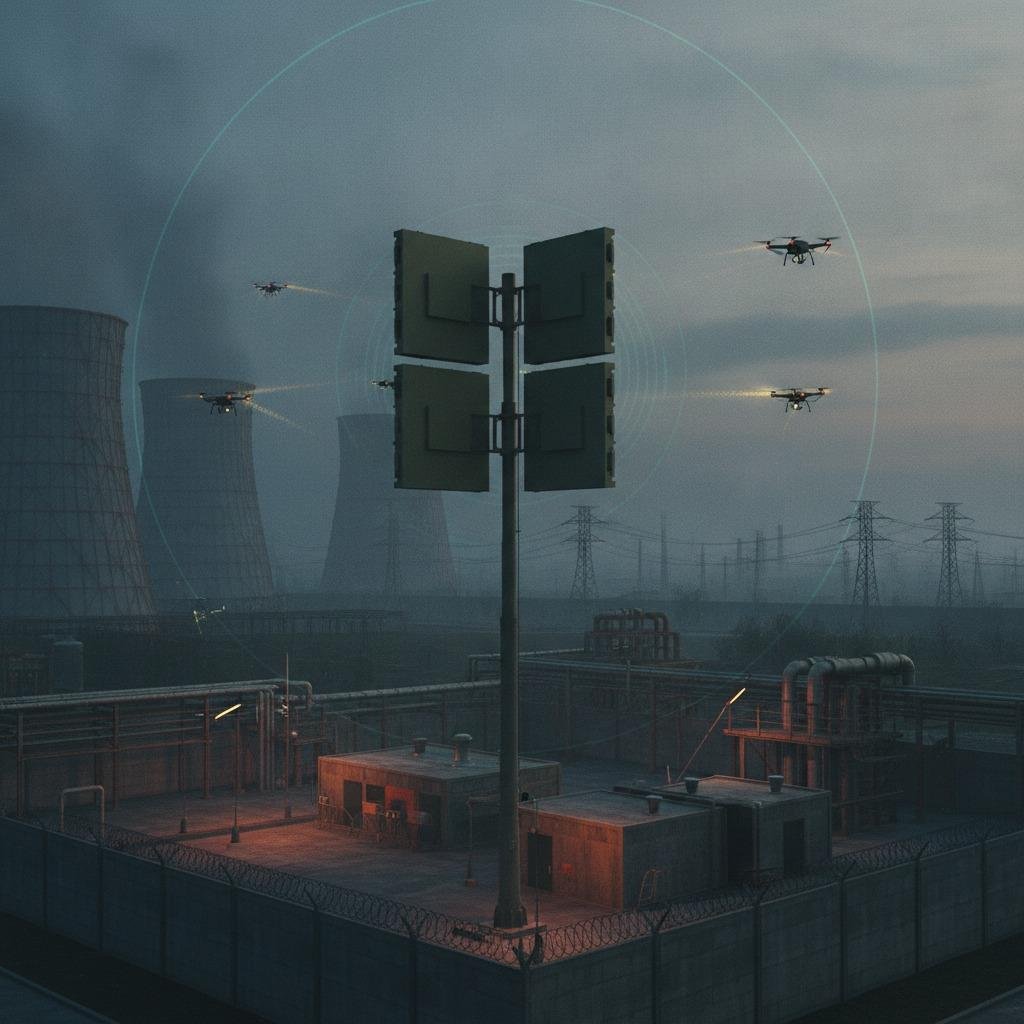
The Multi-Target Saturation Problem in Modern Perimeter Defense
For plant security directors, base defense coordinators, and border infrastructure planners, the threat profile of unmanned aerial systems has shifted dramatically. A lone quadcopter drifting over an exclusion boundary is a manageable incident, usually addressed with direction-finding RF sniffers or pan-tilt cameras. Coordinated group arrivals are an entirely different operational challenge. When several micro-UAVs cross multiple vectors simultaneously, conventional radar architectures choke on signal processing loads, lose tracks in ground clutter, or classify the threat as anomalous noise. Investing in counter-swarm radar surveillance has therefore transitioned from an experimental defense line-item to an immediate procurement priority for critical site infrastructure.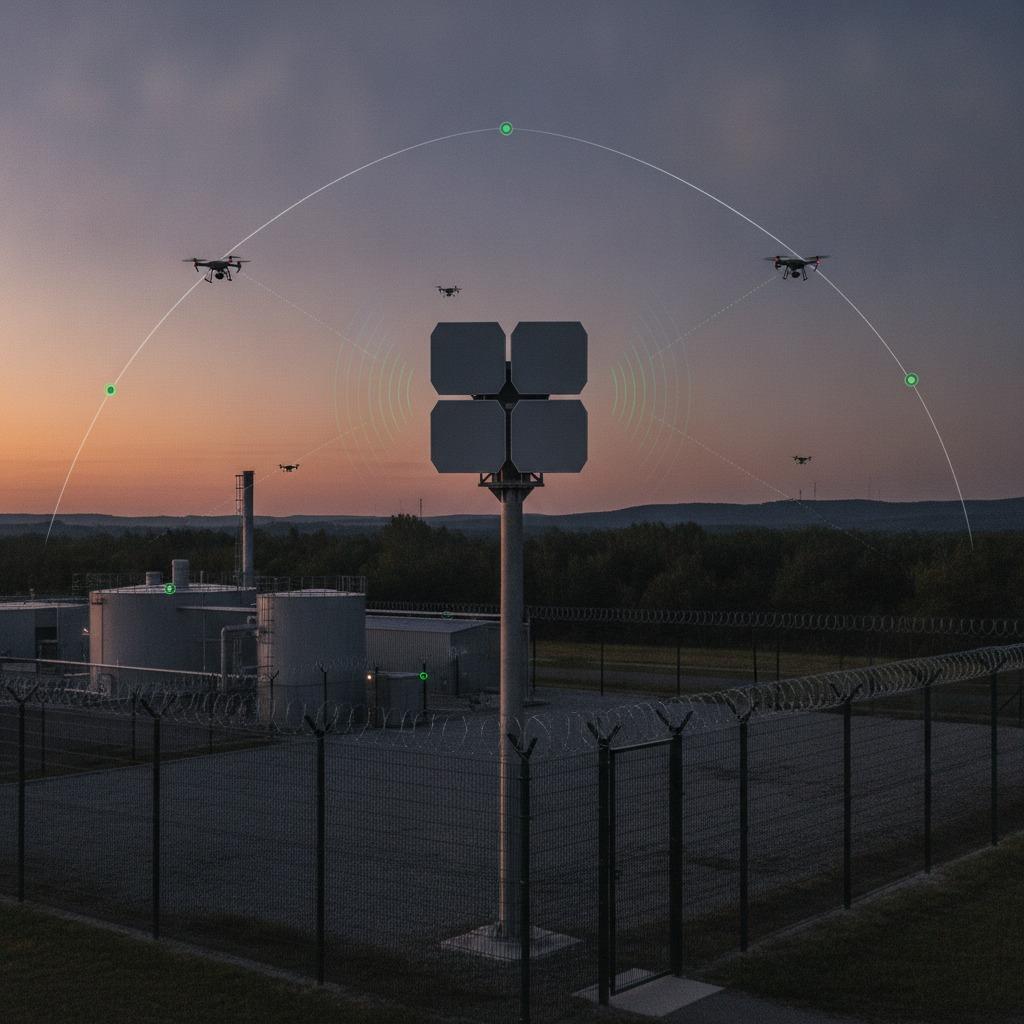
Perimeter teams do not need another theoretical radar spec sheet; they need to understand how radar signal chains hold up when five, ten, or twenty low-reflectivity craft enter the surveillance volume at tree-top level. The decision at hand is rarely about raw transmission wattage. It is about how beamforming architecture, signal processing algorithms, and track management logic handle simultaneous targets without triggering paralyzing false-alarm storms.
Why Traditional Air Defense Radars Drop the Ball on Drone Swarms
Most legacy security radars were dimensioned around conventional aviation targets—helicopters, light aircraft, or cruise missiles—with radar cross-sections (RCS) measured in square meters. Commercial off-the-shelf and modified commercial drones, by contrast, present an RCS often below 0.01 m², mostly composed of non-reflective plastics and carbon fiber with only tiny brushless motors and lithium packs reflecting RF energy.
When a cluster of these platforms maneuvers at low altitudes, legacy sensors encounter three acute operational bottlenecks:
1. Beam Dwell and Update Rates
Mechanically rotating antenna arrays take between one and four seconds to complete a full 360-degree sweep. In a swarm scenario where targets execute aggressive evasive maneuvers or pop up behind ridgelines at 18 to 25 meters per second, a multi-second revisit interval means the radar is plotting stale track points rather than actionable real-time vectors. The track-while-scan filter constantly breaks, resetting target IDs and overwhelming downstream operators.
2. The Clutter Floor and Doppler Confusion
Counter-UAV radar detection depends on picking out target velocities from ground backscatter—treetops blowing in high winds, highway vehicle movement, and sea surface return. Swarming drones frequently hover, fly nap-of-the-earth, or match prevailing wind speeds. If the signal processor applies an aggressive moving-target indication (MTI) notch filter to strip clutter, it inadvertently filters out hovering drones. If sensitivity is cranked up without sophisticated filtering, the system floods the command console with hundreds of nuisance alerts.
3. Track Table Saturation
Older tracking filters assign computational threads sequentially. When twenty targets cross into coverage within three seconds, track correlation logic often misassociates returns, creates phantom split-tracks, or drops valid vectors altogether. In high-density incursions, tracking capacity is just as crucial as raw detection range.
Evaluating Counter-Swarm Architectures: Key Engineering Trade-Offs
Selecting the right radar configuration requires balancing spatial coverage, instantaneous revisit rates, and deployment footprint. Sourcing teams typically evaluate two primary hardware architectures:
| System Parameter | Fixed-Panel 3D Active Electronically Scanned Array (AESA) | High-Rate Continuous-Wave (FMCW) Hybrid Scanning |
|---|---|---|
| Revisit Rate | Sub-second; instantaneous multi-beam dwelling across all sectors. | Moderate (typically 0.5 to 1.5 seconds per sweep). |
| Simultaneous Track Limit | High (hundreds of active tracks processed simultaneously). | Moderate (optimized for 20 to 50 active tracks). |
| Low-Slow-Small (LSS) Target Tracking | Exceptional; continuous energy on target enables micro-Doppler blade extraction. | Good; relies heavily on kinematic track smoothing. |
| Thermal and Power Demands | Higher continuous draw; requires robust environmental heat dissipation. | Lower power budget; well-suited for temporary or mast-mounted units. |
| Relative Total Cost of Ownership | Higher initial capital expense; minimal moving parts reduces field maintenance. | Lower initial cost; mechanical drive components require scheduled servicing. |
For facilities guarding against intentional, coordinated multi-point attacks, fixed-panel 3D AESA operating in the X-band or Ku-band has become the technical baseline. The absence of mechanical azimuth drives allows the radar to synthesize simultaneous receive beams, ensuring continuous track continuity while allocating dedicated energy pulses to interrogate suspected targets.
The Role of Micro-Doppler in Target Disambiguation
One of the hardest operational hurdles in perimeter defense is separating drones from avian activity. Flocks of starlings, geese, or gulls create radar signatures that closely mimic the speed, altitude, and RCS of small multirotors. Generating a radar-based drone intrusion alert every time a bird enters the exclusion envelope quickly leads operator crews to silence the alarm system entirely.
To solve this, advanced systems incorporate small drone signature recognition using micro-Doppler spectral processing. While the drone chassis moves forward at a given baseline velocity, the high-speed rotation of propeller blades produces rapid, cyclical phase shifts in the reflected radar pulse. By analyzing these micro-Doppler sidebands, modern field-programmable gate arrays (FPGAs) can differentiate the distinct biomechanical rhythm of flapping wings from the continuous harmonic frequency of twin- or triple-blade carbon props within fractions of a second.
Sourcing and System Integration Considerations
Before locking in capital equipment specifications for site defense, cross-functional engineering and procurement teams should audit their integration architecture:
C2 and Sensor Fusion Handoffs
Radar is an early cueing sensor, not an identification sensor. It cannot tell an operator what kind of payload an unauthorized drone is carrying. Your radar software layer must publish low-latency track coordinates via standardized defense protocols (such as Asterix Cat 010/240 or open API/REST interfaces) to slave electro-optical/infrared (EO/IR) cameras directly onto target vectors. If the handoff latency exceeds 200 milliseconds, narrow-field-of-view thermal cameras will consistently swing behind fast-moving drones and fail to lock on.
Frequency Deconfliction and Site Topography
Ku-band systems offer razor-sharp angular resolution and compact panel sizes, but they suffer noticeable attenuation in heavy rainfall or coastal fog compared to S-band or C-band radars. Conversely, lower-frequency radars struggle with vertical height accuracy and ground multipath reflections near flat water or asphalt tarmac. A realistic site survey must dictate operating frequency, not catalogue marketing ranges measured in desert testing conditions.
Electronic Countermeasures Compatibility
If your defense scheme includes active RF jammer defeat systems, the radar must feature built-in frequency agility and digital filtering to prevent front-end saturation from local jamming harmonics. Operating an active jammer next to an unhardened surveillance radar frequently blinds the radar receiver, effectively cutting off situational awareness the moment interdiction begins.
Frequently Asked Questions
Can counter-swarm radars distinguish between friendly and hostile drones operating together?
Pure radar systems cannot definitively confirm friend-or-foe status without cooperative transponders (like Remote ID or Mode 5 IFF). In contested airspace, the radar provides velocity, coordinate, and signature data, while integration with local RF sniffing sensors and whitelisted flight telemetry in the command-and-control software determines intent.
How many radar panels are needed for complete 360-degree perimeter protection?
For stationary AESA implementations, full spherical or hemispherical coverage typically requires three to four fixed planar panels mounted on a central mast or building corners, each covering a 90- to 120-degree azimuth sector with 30- to 40-degree elevation clearance to mitigate overhead blind funnels.
What is the primary factor limiting radar detection range against micro-drones?
Target RCS and ground clutter backscatter, rather than radar transmitter power. Detecting an object with an RCS of 0.01 m² against clear sky at three kilometers is far easier than detecting that same object at 800 meters skimming four meters above tree lines or metal perimeter fencing.
Action Plan for Procurement Teams
If your facility is upgrading perimeter security to address low-altitude multi-vector threats, do not rely exclusively on vendor-provided simulated demonstrations. Request a blind field test that explicitly incorporates at least three simultaneous micro-drones flying coordinated overlapping paths near terrain clutter. Insist on reviewing raw false-alarm rates over a 48-hour continuous deployment alongside target tracking logs. Evaluating how cleanly the sensor differentiates mechanical blades from environmental clutter during live flight trials is the only dependable way to validate multi-target readiness.