





When perception engineers deploy FMCW radar across automated warehousing, robotics, or active transit corridors, extracting clean kinematic data from dense background noise remains an unyielding challenge. The fundamental issue is well-known: reliable Doppler velocity detection depends on isolating subtle phase shifts across consecutive chirp reflections, but surrounding static surfaces—like structural steel beams, concrete dividers, and equipment enclosures—routinely overwhelm the receiver with high-amplitude return signals. When the radar front-end is saturated with non-moving reflections, subtle micro-Doppler signatures from vulnerable personnel or slow-moving autonomous guided vehicles (AGVs) disappear into the noise floor.
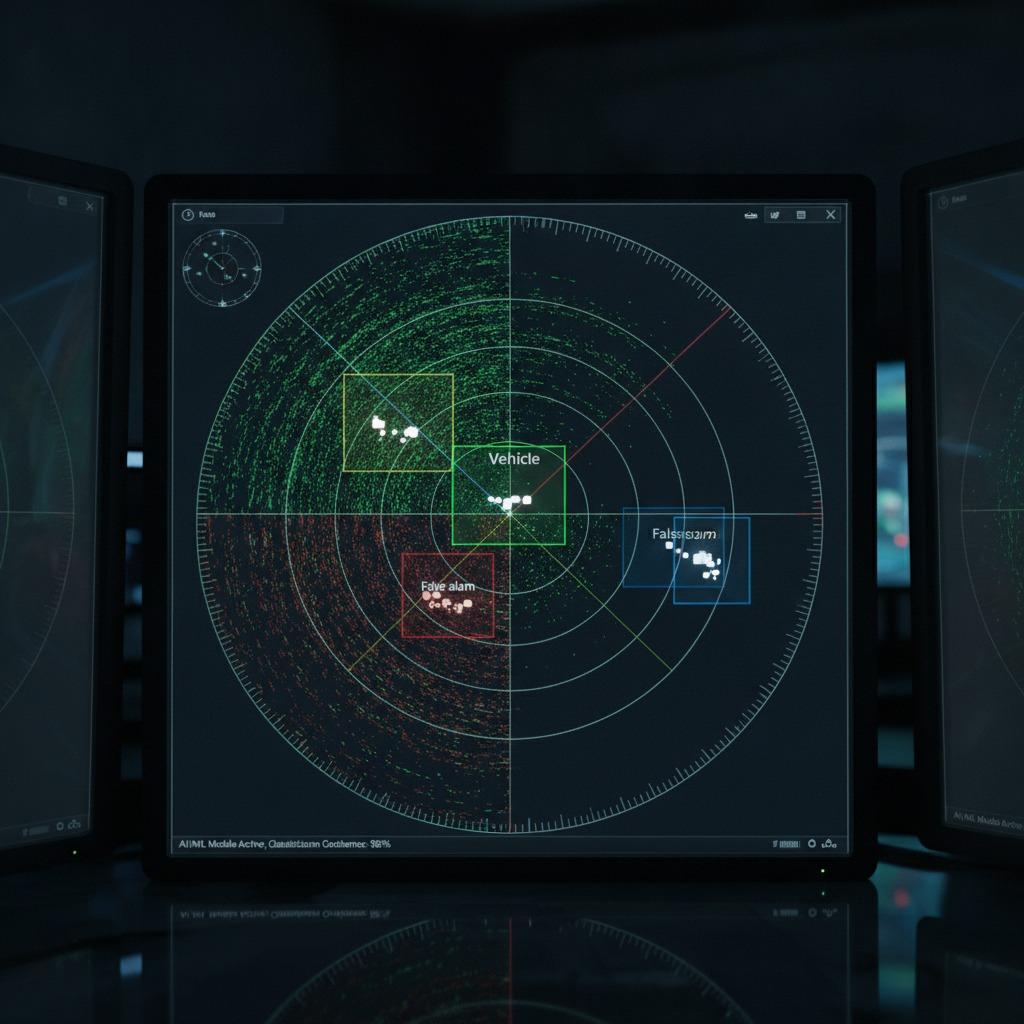

The Signal-to-Clutter Bottleneck
In idealized testing chambers, tracking an isolated reflector across range and velocity bins is trivial. Real-world industrial environments, however, degrade radar point clouds in distinct ways:
- Multipath Ghosting: Metallic barriers mirror transmitted RF energy, creating synthetic targets with non-zero velocities that fool naive threshold algorithms.
- Phase Noise Masking: High-power zero-Doppler reflections elevate the phase noise floor across the entire velocity axis, blinding detectors to low-RCS (radar cross-section) targets moving nearby.
- Spatial Smearing: Targets moving along tangential trajectories present near-zero radial velocity relative to the transceiver, causing them to be prematurely filtered out by simplistic high-pass filtering networks.
Solving these issues requires moving past basic range-Doppler map generation toward a multi-stage filtering and spatial processing chain.
A Tiered Processing Framework for Dynamic Radar
Rather than relying on raw receiver gain or brute-force constant false alarm rate (CFAR) thresholds, modern sensor architectures address interference systematically across spatial, temporal, and spectral domains.
1. Zero-Velocity Filtering and Stationary Clutter Removal
The first line of defense is Stationary clutter removal applied before range-Doppler bins are passed downstream. Traditional moving target indication (MTI) high-pass finite impulse response (FIR) filters often cut too aggressively, suppressing slow-moving human targets whose radial velocity hovers close to zero. Instead, modern implementations favor adaptive mean-subtraction or state-space filtering across consecutive pulse-repetition intervals (PRIs). By continuously estimating the static component of the channel response, the system subtracts fixed environmental echoes without notching out low-velocity kinematics.
2. Directional Isolation via Adaptive Beamforming
Once raw stationary bias is mitigated, spatial ambiguity must be resolved. Fixed spatial windowing frequently leaks energy from strong side-lobe reflectors into adjacent angular bins. By leveraging Adaptive beamforming routines—such as Minimum Variance Distortionless Response (MVDR) or directional null-steering—the system dynamically adjusts antenna array weights. This steers antenna pattern nulls toward high-reflectivity stationary obstacles while preserving gain in directions displaying actionable velocity signatures.
3. Point-Cloud Clustering and Moving Object Segmentation
Extracting target boundaries from sparse radar returns is inherently more difficult than performing spatial edge detection on dense optical images. Robust Moving object segmentation relies on evaluating radial velocity consistency across localized clusters of detected points. Algorithms like Density-Based Spatial Clustering of Applications with Noise (DBSCAN), augmented with a Doppler dimension (Range-Azimuth-Doppler clustering), prevent split-target artifacts where a single vehicle appears as three disjoint entities moving at slightly staggered velocities.
4. Pipeline Persistence Through Dynamic Scene Updating
Point detections are volatile; occlusions and momentary antenna cross-section dips cause dropped detections. A deterministic Dynamic scene updating loop links segmented clusters into cohesive track states via unscented Kalman filters (UKF) or joint probabilistic data association (JPDA). This framework maintains target identity across frame boundaries even when an object halts at an intersection and briefly produces zero Doppler shift.
System Selection Criteria: Hardware and Computational Trade-Offs
Before locking in a radar transceiver and companion DSP or FPGA architecture, development teams must reconcile processing latency against resolution thresholds:
| System Parameter | Design Impact | Engineering Caution |
|---|---|---|
| Chirp Repetition Time (T_c) | Dictates maximum unambiguous velocity. | Shorter chirp cycles raise ADC throughput demands and inter-chirp reset constraints. |
| Frame Duty Cycle | Determines track continuity and latency. | High duty cycles cause thermal throttling in passive enclosures, altering RF carrier stability. |
| Virtual Array Count | Governs angular resolution via MIMO synthesis. | Expands matrix inversion operations in beamforming, ballooning DSP memory footprints. |
Common Architectural Oversights
A frequent error during early hardware bring-up is offloading clutter suppression entirely to software layers running on a secondary host application processor. Transferring raw ADC buffers or massive 3D range-Doppler-azimuth cubes over SPI or Ethernet quickly bottlenecks available bus bandwidth. Front-end processing—specifically initial 2D FFTs, static matrix subtraction, and threshold generation—should execute on-chip or directly inside an adjacent FPGA.
Another blind spot is tangential acceleration. Simple Doppler processing assumes radial velocity remains constant over the frame period. In high-speed turns or erratic robotics trajectories, radial acceleration causes energy to disperse across multiple Doppler bins, degrading detection sensitivity. System architects should monitor chirp integration times to ensure targets do not cross velocity bins during a single coherent processing interval (CPI).
Frequently Asked Questions
How does Doppler processing perform when target motion is purely perpendicular to the sensor?
When an object travels at a strict 90-degree angle to the radar beam, its radial velocity drops to zero. In these scenarios, Doppler detection cannot distinguish the target from static clutter using frequency shift alone. The tracking layer must fall back on multi-frame spatial displacement tracking, or the system must use multiple radar nodes arranged with overlapping, orthogonal coverage.
Can frequency-domain filtering eliminate multipath reflections entirely?
No. Multipath returns often carry non-zero Doppler shifts because the moving reflector imparts its velocity onto the indirect bounced signal. Combating multipath requires combining spatial plausibility checks, track-history gating, and digital beamforming that rejects returns outside acceptable line-of-sight elevation and azimuth envelopes.
Next Steps for Sensor Integration
Deploying reliable tracking in high-clutter environments begins with benchmarking your raw RF return profile under peak operational noise. Before finalizing software filters, verify that your chosen transceiver architecture supplies sufficient dynamic range to withstand high-amplitude zero-velocity returns without driving the low-noise amplifier (LNA) into saturation. Reviewing chirp timelines, virtual channel geometry, and processing hardware concurrently prevents costly PCB redesigns late in the product development cycle.